
Purnima Lallan Sharma Foundation · Est. 2021
PLS FoundationPLS FOUNDATIONEducate. Empower. Care.

PLS FOUNDATION

Choose a learning path

Build one useful ability through a short sequence of free lessons. English and Hindi, with worked examples and answers.

Choose the ability you want to build. Open any lesson directly, or follow its series in order. Read one explanation, try the task on paper, and compare your reasoning with the answer before moving on.

The circular historic Parliament House in New Delhi behind trees, a road and landscaped gardens.
The historic Parliament House in New Delhi, photographed in 2014. · Nikhil B (Nikhilb239) · CC BY-SA 4.0

4 LESSONS · SELF-PACED

Make sense of public life

Follow a law, identify a local body, read a budget and understand representation.

Beginner explanations; each process has a worked example.

  1. How Parliament makes a law: follow an ordinary Bill
  2. Local government: panchayats, municipalities and everyday services
  3. Read a public budget and ask evidence-based questions
  4. Elections and representation: find reliable voter information
Open this learning path →
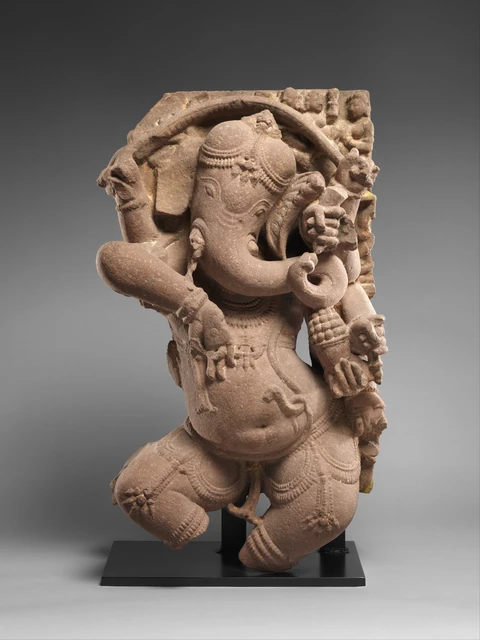
A red-sandstone sculpture of elephant-headed Ganesha ji dancing, with multiple arms and a snake held above his head.
Dancing Ganesha, Madhya Pradesh, about the 10th century, Kalacuri dynasty; red sandstone. The Metropolitan Museum of Art, 2007.480.2. · Unknown sculptor; image: The Metropolitan Museum of Art · CC0 1.0 (public domain)

5 LESSONS · SELF-PACED

Know Ganapati ji through his stories

Follow Maa Parvati’s son, the brothers’ journey, the Atharvashirsha and Ganesh Chaturthi.

Beginner to intermediate; five substantial connected lessons.

  1. Ganapati ji: his stories, family, names and sacred form
  2. Maa Parvati’s son: Ganapati ji’s doorway, restoration and honour
  3. Ganapati ji and Bhagwan Kartikeya: a journey around the world
  4. Ganapati Atharvashirsha: devotion, truth and Brahman
  5. Ganesh Chaturthi: welcome, worship, sharing and farewell
Open this learning path →
Kalighat painting of Hanuman ji carrying a leafy mountain above Shri Rama, who supports the injured Shri Lakshmana.
Hanuman ji brings the mountain to Shri Lakshmana in this Kalighat painting, illustrating a later Ramayana episode. · Wellcome Library, London · CC BY 4.0

4 LESSONS · SELF-PACED

Follow Hanuman ji’s journey

Meet Shri Rama, cross the ocean, find Maa Sita and follow the return with news.

Beginner; four connected episodes with reflection and explained answers.

  1. Hanuman ji meets Shri Rama and Shri Lakshmana: speech that opens friendship
  2. Hanuman ji crosses the ocean: Mainaka, Surasa and Simhika
  3. Hanuman ji finds Maa Sita: careful speech, Shri Rama’s ring and her message
  4. Hanuman ji returns with news: courage completed by faithful service
Open this learning path →
A manuscript page of the Isha Upanishad with lines of handwritten Sanskrit in Devanagari and red verse markers.
An Isha Upanishad manuscript, folio 1r, Wellcome MS Indic 37. · Wellcome Library, London · CC BY 4.0

4 LESSONS · SELF-PACED

Think with the Upanishads

Explore the questions of Nachiketa, Shvetaketu, Maitreyi and Gargi.

Intermediate; start with the linked introduction to self and Brahman.

  1. Nachiketa and Yama Deva: three boons, a difficult choice, and the chariot
  2. Uddalaka and Shvetaketu: clay, the seed, salt, and tat tvam asi
  3. Yajnavalkya and Maitreyi: wealth, love, and knowing the knower
  4. Gargi and Yajnavalkya: the woven world and the Imperishable
Open this learning path →
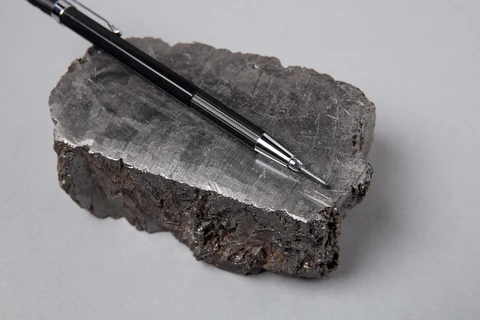
A dark grey graphite specimen with a black mechanical pencil laid diagonally across it.
A graphite specimen with a mechanical pencil, from the Auckland Museum collection. · Auckland Museum Collections · CC BY 2.0

4 LESSONS · SELF-PACED

Understand everyday materials

Use particles, properties and bonding to explain materials and their uses.

Begin with the linked atoms lesson if elements and compounds are new to you.

  1. Acids, bases and what indicators can tell us
  2. The periodic table: reading patterns and making predictions
  3. Metals, non-metals and choosing a material
  4. Carbon bonding and everyday compounds
Open this learning path →
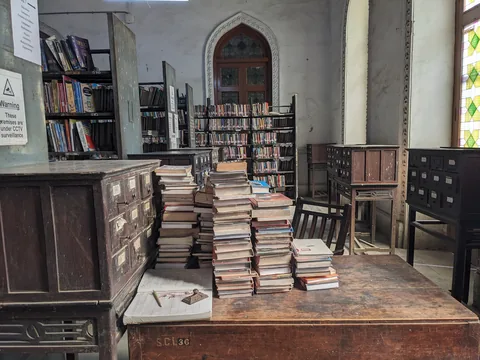
Stacks of books, wooden catalogue drawers and bookshelves inside the State Central Library in Hyderabad.
State Central Library, Hyderabad; photographed in December 2024. · Saiphani02 · CC BY 4.0

4 LESSONS · SELF-PACED

Read carefully. Express an idea.

Find the main idea, revise a paragraph, take faithful notes and discuss a disagreement.

Start with everyday reading; no specialist vocabulary is assumed.

  1. Read for meaning: main idea, evidence and inference
  2. Write a clear paragraph and revise it
  3. Listen, take useful notes and summarise faithfully
  4. Ask useful questions and disagree respectfully
Open this learning path →

Make the path fit your circumstances

You can switch between English and Hindi at any lesson. Print a page or save it as a PDF from your browser for later study. For a shared device, take turns explaining one step; a notebook is enough to keep your attempts. Your pace is your own, and reading is never conditional on a donation.

Session plans for a class or study circle → Browse every subject →