
The core idea
Ganesha, also called Ganapati, is revered as a remover of obstacles and a lord of beginnings. His worship can express humility before a new responsibility. An image, a prayer and a practical act of preparation can work together: devotion gives the beginning meaning, while thoughtful effort carries the work forward.
Ganapati and the meaning of a beginning
Ganesha is recognised by his elephant head and is associated with Shiva and Parvati. Ganapati and Vinayaka are familiar names used in worship. The request to remove obstacles is not merely a request for convenience: a beginning often exposes impatience, fear and lack of preparation. A learner can approach this devotion as a moment to become attentive before acting. That reflection is an application of the teaching, not a promise that every external difficulty will disappear.
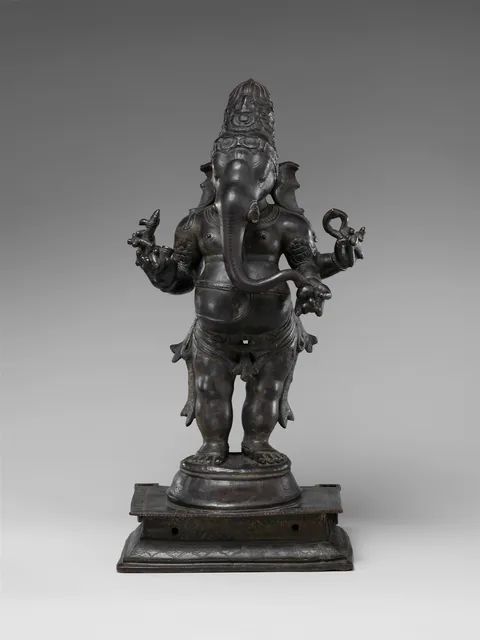
Read a real sculpture carefully
The bronze pictured here comes from Tamil Nadu and is dated by the museum to the twelfth century. Notice the trunk, rounded body and multiple hands before reading the label. This particular image includes a sweet, an axe, a noose and a tusk. Other images need not carry exactly the same objects. A dated sculpture tells us that artists and patrons were making this form in a particular historical setting; its date is not a claim about when Ganesha first existed in sacred tradition.
Symbols invite attention rather than a single code
A symbol can carry several readings. The broken tusk may lead a storyteller to one episode and a devotee to a reflection on sacrifice. Large ears may inspire the practical lesson of listening well. It is useful to say which kind of explanation we are giving: the story attached to a specific image, a teaching passed on by a family, or our own reflection. This keeps the richness of the tradition without turning every appealing interpretation into an ancient quotation.
A small beginning practice you can choose
You may sit quietly, remember Ganesha by a familiar name, and state the task you hope to undertake honestly. If it belongs to your household custom, a flower or a small food offering may accompany prayer. Another person may prefer reading, silent remembrance or joining a temple aarti. There is no requirement to buy an expensive set of objects to use this learning exercise. The Siddhivinayak Trust’s schedule shows how a temple orders its own worship; that institutional routine is not a universal timetable for every home.
Worked example: beginning a youth study circle
Imagine that five friends want to teach younger children on Sundays. A meaningful beginning could include a short prayer followed by three concrete commitments: arrive on time, check the teaching material and listen patiently. The first obstacle turns out to be an inaccessible room, not a shortage of enthusiasm. Moving the session to an accessible place makes the intention real. The point is not to use ritual to avoid responsibility, but to let remembrance sharpen the responsibility already accepted.
Carry the beginning into the rest of the day
At the end of a task, ask what helped and which obstacle still needs attention. Thank people who contributed. A prayerful beginning and an honest review can belong to the same practice. If you are visiting a temple, read that temple’s current guidance about queues, offerings and photography. If you are studying at home, it is enough to start with one understood idea. Regularity grows more naturally from a practice that is manageable than from a long list undertaken only from fear.
PUT IT INTO PRACTICE
Work through an example
- Choose a task and name one obstacle you can influence.
- Write a short intention; choose prayer, reflection or both.
- Take one practical step, then review whether it helped.
Check your understanding
What identifies the pictured deity?
The elephant head identifies Ganesha; the other attributes help identify this particular form.
Does a sculpture’s date date the deity?
No. It dates the material object and its historical context.
Must every home follow a temple timetable?
No. A temple organises its own community worship; households have their own circumstances and traditions.
How did the study group address its obstacle?
It changed the inaccessible venue, connecting intention with a concrete responsibility.