
The core idea
Ganapati honours and circles Shiva and Parvati, then explains why this fulfils the spiritual purpose of circling the earth. The story praises intelligence joined to reverence. Its continuation also asks us to notice Kartikeya’s hurt and the effect of the way news is conveyed.
A household with two beloved sons
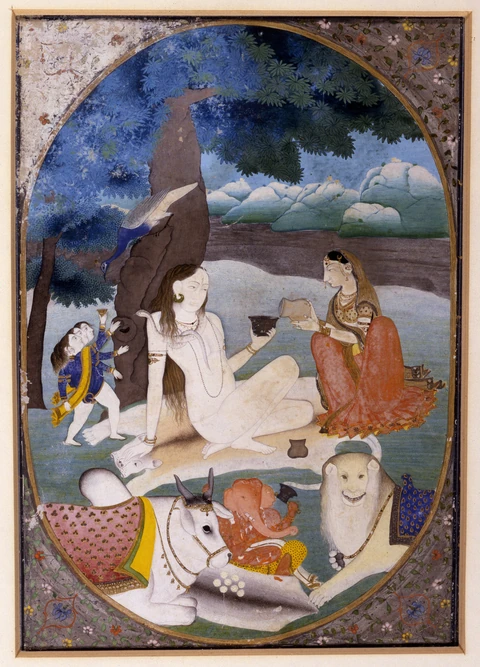
Kumara-khanda 19 opens with affection. Shiva and Parvati watch their sons’ activities with delight; the sons in turn serve their parents devotedly. The parents’ love for Ganapati and Shanmukha, another name for Kartikeya, increases like the brightening moon. This opening is essential to the episode. We are not introduced to one loved child and one unwanted rival. The parents consider the marriages of both sons, and each son wants his own marriage to happen first. The disagreement becomes repeated and insistent. Shiva and Parvati decide on a test: the son who travels around the entire earth and returns first will marry first. The sacred family scene presents a familiar difficulty in an extraordinary setting—how can equal affection be maintained when two people want precedence? The narrative’s response unfolds through action and argument. Listen for what the parents intend, what each son understands, and how the result is later received.
Sources: Shiva Purana, Rudra-samhita, Kumara-khanda: Sanskrit, chapters 13–20 ↗
One brother travels; one brother considers
Kartikeya sets out promptly to circle the earth. Ganapati remains and considers his difficulty. The Sanskrit makes his reflection explicit: covering even a short distance is hard for him, so what should he do about the whole earth? This pause is not presented as the end of effort. He uses it to reconsider what fulfilment of the task might mean. Then he bathes, returns to his parents and prepares seats for their worship. Each step changes the scene from a contest of speed to an act of reverence. To understand his intelligence, follow the work it requires: he recognises a limitation, thinks through a principle, makes a plan, acts and explains. That is a much fuller sequence than simply ‘the clever brother found a trick.’ Kartikeya’s readiness to travel is also an active response. The brothers begin with different abilities and methods; their difference supplies the question the rest of the chapter explores.
Sources: Shiva Purana, Rudra-samhita, Kumara-khanda: Sanskrit, chapters 13–20 ↗
The seven circuits around his parents
Ganapati asks Shiva and Parvati to sit on the prepared seats. He worships them, circles them repeatedly and bows. The chapter then has him say he has circled the earth seven times; seven is the number in this account. With folded hands and praise, he asks that his marriage now be performed. The parents initially remind him of the original instruction: Kartikeya has gone around the earth, and he too should make that journey. This exchange matters because his act does not remain an unexplained private interpretation. Ganapati must make its meaning intelligible to those who gave the task. The physical movement is modest, but the relationship it honours is immense. Circumambulation places the honoured presence at the centre while the worshipper moves around it. Here Shiva and Parvati are at once his parents and the divine couple. The story gives both dimensions room: tenderness towards those who care for him and reverence towards the sacred source of his world.
Sources: Shiva Purana, Rudra-samhita, Kumara-khanda: Sanskrit, chapters 13–20 ↗
The argument: a nearby place of pilgrimage
Ganapati’s reasoning in verses 37–44 appeals to teachings that praise worship and circumambulation of one’s parents as bearing the merit of circling the earth. He describes their feet as a great tirtha, a sacred place of crossing or pilgrimage, available close at hand. His point has force because the task is not being read as a modern sporting event measured only by kilometres. It belongs to a sacred world in which the value of an action includes relationship, intention and dharma. The parents listen and accept his reasoning. They praise the intelligence that becomes clear in difficulty, comparing the disappearance of sorrow through understanding to darkness giving way before the sun. For learners, the question becomes: can I explain why my chosen action serves the purpose of a task? An alternative solution gains strength when its reasons can be examined. Ganapati does not merely announce victory; he connects his action to a principle that his parents recognise.
Sources: Shiva Purana, Rudra-samhita, Kumara-khanda: Sanskrit, chapters 13–20 ↗
Siddhi, Buddhi, Kshema and Labha
Chapter 20 moves to the wedding celebration. Vishvarupa’s daughters Siddhi and Buddhi are married to Ganapati, and the gods and sages share the joy. Later the text names two sons: Kshema, born to Siddhi, and Labha, born to Buddhi. These names give the family a distinctive shape in this account. The relationships place accomplishment and understanding within one sacred household. The names themselves provide an additional layer of teaching. Siddhi suggests accomplishment, Buddhi intelligence or understanding, Kshema wellbeing and security, and Labha gain. Consider a student project: finishing it is an accomplishment; understanding it requires intelligence; protecting the group’s wellbeing matters; and what the group gains should be useful. This reflection connects the sacred names with qualities we can recognise in daily work. The narrative first presents persons and relationships, and those names then invite contemplation.
The family named in this account
| Relationship | Names in Kumara-khanda 19–20 | Place in the narrative |
|---|---|---|
| Parents | Parvati and Shiva | Give the test and accept Ganapati’s reasoning |
| Brothers | Ganapati and Kartikeya / Shanmukha | Respond to the journey in different ways |
| Ganapati’s wives | Siddhi and Buddhi | Vishvarupa’s daughters in chapter 20 |
| Ganapati’s sons | Kshema from Siddhi; Labha from Buddhi | Named in chapter 20, verse 8 |
This table follows the named textual account; other sacred representations may use different family names.
Sources: Shiva Purana, Rudra-samhita, Kumara-khanda: Sanskrit, chapters 13–20 ↗
Kartikeya’s return changes the tone
The story continues after Ganapati’s success. Kartikeya returns from his journey, and Narada tells him what has happened. His report stresses that Ganapati’s marriage has already taken place and presents the parents’ conduct as unfair to Kartikeya. The listener’s emotional response is therefore shaped not only by an event but by the manner of its telling. Kartikeya feels hurt and angry, bows to his father and leaves for Krauncha mountain despite his parents’ attempts to stop him. The chapter continues to honour him; his departure is not an invitation for readers to ridicule him as an unintelligent loser. This ending complicates a simple victory tale. An accepted argument can settle a decision while feelings remain unsettled. When telling the episode to children, allow both the delight in Ganapati’s wisdom and sympathy for Kartikeya’s disappointment. The presence of both responses makes the story more humane and makes its family relationships more memorable.
Sources: Shiva Purana, Rudra-samhita, Kumara-khanda: Sanskrit, chapters 13–20 ↗
Wisdom, care and the measure of a journey
The episode offers several measures of action. Kartikeya undertakes an outward journey; Ganapati recognises a sacred centre close at hand. The parents judge the argument through dharma; Kartikeya later experiences the outcome through the expectations with which he departed. We can learn from each perspective. Looking far away for something admirable can make us overlook nearby responsibilities, while staying near must not become an excuse to avoid effort. A pilgrimage can be meaningful, and so can patient care within a household. The story’s praise of parental reverence can be practised through gratitude, attentive listening and useful help, according to one’s actual family circumstances. It need not become a competition between families or an order to accept harmful treatment. A thoughtful reader keeps the generous centre of the teaching: recognise what sustains your life and respond with care. Understanding becomes wisdom when it guides both the solution of a problem and the way other people are treated afterwards.
Three worked reflections
Case 1 — What is at stake in the journey? Model answer: these Shiva Purana chapters concern which brother will marry first. Naming that condition makes Ganapati’s claim and the wedding in chapter 20 fit together. Follow the chain: the parents set a condition, Ganapati explains its fulfilment, and the accepted explanation leads to his marriage.
Case 2 — A student finds a shorter method. What makes it a sound solution? Model answer: explain the task’s purpose, show each step and demonstrate that the result fulfils the agreed aim. Ganapati’s reasoning is relevant because he gives an account of why the act is sufficient; merely calling something clever would not establish that.
Case 3 — How might one report a result with care? Model answer: describe the decision and its reasons, acknowledge the other person’s effort and allow questions. Comparing this with Narada’s strongly framed report helps us notice how words can intensify hurt. The practice aims at truthful speech joined to consideration.
PUT IT INTO PRACTICE
Try three connected practices
- Retell the test, the two responses, Ganapati’s argument and Kartikeya’s return in four paragraphs.
- Draw the family exactly as chapter 20 names it, then write one reflection on each of Siddhi, Buddhi, Kshema and Labha.
- Write a considerate three-sentence explanation of a group decision to someone disappointed by it.
Check your understanding
How many circuits does Ganapati claim?
Seven, in Kumara-khanda 19.33. He grounds the claim in his worship and circumambulation of Shiva and Parvati.
Why is his response more than a shortcut?
He acts in reverence and explains a recognised religious principle. The parents examine and accept that explanation.
Which wives and sons are named here?
Siddhi and Buddhi, daughters of Vishvarupa; their sons are Kshema and Labha respectively. This answer describes this text’s family account.
What does Kartikeya’s response add?
It shows the emotional consequences of the result and the power of its telling. A complete reading respects him while appreciating Ganapati’s wisdom.