
The core idea
In this Shiva Purana telling, Ganapati receives an elephant’s head after the conflict at Parvati’s door. The full story also explains his leadership of the ganas and precedence in worship. Its emotional centre is Parvati’s love and her demand that her son be restored and honoured.
How the Purana invites us to listen
Narada has heard the account of Kartikeya and asks Brahma to tell him about Ganapati. That conversation, reported by Suta, opens chapter 13. We enter a tradition of listening: a question leads to a sacred account, and the listener’s attention becomes part of its transmission. Brahma first acknowledges different accounts associated with different kalpas, or cosmic cycles, then announces the Shveta-kalpa telling followed here. In that telling Shiva is praised as the supreme lord whose lila encompasses creation, preservation and dissolution. The subsequent scenes therefore belong within the Purana’s devotional vision, even when divine characters experience recognisably human emotions. The narrative can be approached with both reverence and careful questions. Why does Parvati seek an attendant of her own? Why does the confrontation grow? What has to happen before peace is restored? Keeping these questions in view helps us hear more than a short explanation of an elephant head.
Sources: Shiva Purana, Rudra-samhita, Kumara-khanda: Sanskrit, chapters 13–20 ↗
Parvati creates, blesses and entrusts
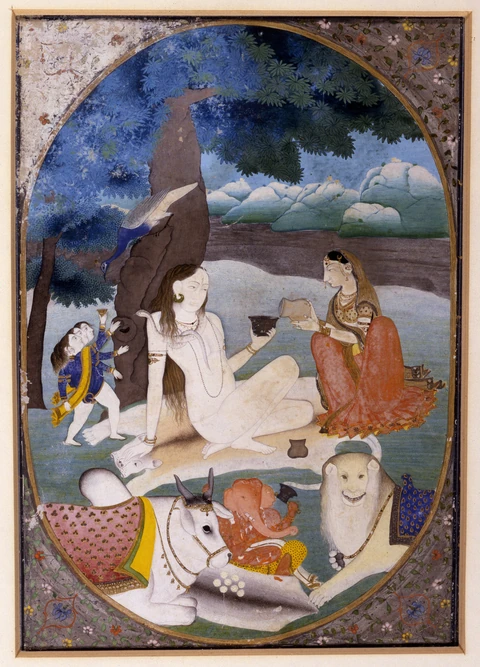
Jaya and Vijaya point out that the attendants surrounding the household follow Shiva’s commands. Parvati recognises the need for someone whose duty is to attend to her instructions. After an occasion when her privacy during bathing has been interrupted, she gives form to a boy from the substance of her body. The Sanskrit calls that substance mala; the scene stresses her divine creative power rather than describing an ordinary birth. She dresses and adorns the boy, blesses him and explicitly calls him her own son. When he asks what he should do, she gives him a staff and the responsibility of guarding the entrance. She embraces and kisses him before he takes his place. These affectionate actions establish him as a beloved son whose service grows from a relationship. In retelling the scene, give equal attention to the mother’s tenderness and the boy’s readiness; both prepare us to understand why the later confrontation matters.
Sources: Shiva Purana, Rudra-samhita, Kumara-khanda: Sanskrit, chapters 13–20 ↗
At the threshold, two claims meet
The boy’s instruction is to admit nobody without his mother’s permission. Shiva arrives and finds himself stopped at his own doorway by someone who does not know him. He declares who he is; the boy remains committed to the instruction he has received. The encounter quickly becomes forceful. Shiva asks the ganas to deal with the unfamiliar gatekeeper, but they also meet resistance. Chapter 14 allows us to hear the quarrel: the established attendants speak from their authority as Shiva’s followers, while the new guardian insists on the responsibility entrusted to him. This is a dramatic meeting of identity, authority and duty. A useful reflection is that commitment needs communication as well as courage. In ordinary life, two people may each be following a real responsibility and still misunderstand one another. The story does not become smaller when it invites that reflection; it gives the listener a vivid doorway through which to think about their own conduct.
Sources: Shiva Purana, Rudra-samhita, Kumara-khanda: Sanskrit, chapters 13–20 ↗
A doorway dispute becomes a cosmic conflict
Chapters 15–16 enlarge the scene. Ganapati’s extraordinary power astonishes the assembled forces. Parvati creates powers to support him; their presence shows that the mother remains an active participant in the narrative. Weapons and opposing forces do not easily overcome the boy. The scale of the fighting grows until Shiva severs his head during the battle. In a brief retelling, it is easy to leap straight from the first refusal to the elephant head and lose the intervening tragedy. The longer account gives us a different rhythm: repeated confrontation, increasing force, irreversible loss, grief and only then restoration. A family discussion can name the event plainly without dwelling on graphic details. Children can understand that a terrible harm occurs and that the story will address it. The theological frame of lila does not require us to ignore Parvati’s sorrow. The Purana itself gives that sorrow enough importance to change the direction of the entire divine assembly.
Sources: Shiva Purana, Rudra-samhita, Kumara-khanda: Sanskrit, chapters 13–20 ↗
The mother asks for life and dignity
Chapter 17 begins with Parvati’s grief and anger. She manifests many shaktis, and the resulting crisis makes the gods seek a way to restore peace. The sages approach her with praise, recognising her as the primordial power that creates, sustains and dissolves the world. They ask forgiveness and speak with folded hands. Parvati then names two conditions: her son must live again, and he must receive an honoured position among them. The second condition is easy to miss. Survival alone will not complete the repair; the child’s place must change. Her words move the story from defeating an opponent to restoring a relationship. A modern ethical reflection can grow from this without pretending to be the only meaning of the Purana: after harm, an apology gains substance through an action that repairs what was damaged. The text itself supplies the concrete action here—restored life, leadership and worship—rather than leaving peace as a vague feeling.
Sources: Shiva Purana, Rudra-samhita, Kumara-khanda: Sanskrit, chapters 13–20 ↗
The elephant head and the return of joy
Shiva agrees that Parvati’s conditions should be met. The attendants are sent north and instructed to bring the head of the first being they encounter. In this Sanskrit account, the elephant they meet is already described as single-tusked. Its head is joined to the boy’s body. The gods invoke divine energy and sprinkle water consecrated with mantras; the child awakens as from sleep by Shiva’s will. The narrative presents this as a divine restoration, and the language turns from fear to beauty, brightness and joy. Ganapati is shown to Parvati, whose delight answers the anguish of the preceding scene. Notice how the same mother who originally clothed and embraced him will now embrace him again. The renewed affection completes an arc that began before the battle. Ganapati’s elephant form is therefore encountered within a story of both profound transformation and continuing identity: he remains Parvati’s beloved son, now entering a new place among the gods.
Sources: Shiva Purana, Rudra-samhita, Kumara-khanda: Sanskrit, chapters 13–20 ↗
From guarded door to auspicious beginning
In chapter 18 Parvati gives clothing, adornment, affection and blessings. Shiva places his hand on Ganapati’s head and acknowledges him as his son. Ganapati bows to his parents and to the divine assembly. The gods grant honour, and Shiva establishes him as the leader of his ganas. His precedence in worship is stated, and offerings, praise, music and celebration follow. The ending is communal: the assembly that participated in conflict now participates in welcome. Read the first and last scenes together. At the beginning one boy stands before a closed entrance; at the end the gods recognise his authority and receive him into their worship. This movement helps explain why devotees remember him at thresholds such as study, travel, marriage or a new responsibility. A beginning can carry an aspiration that the work ahead be guided by clear understanding and good relationships. Ganapati’s first place remembers a completed reconciliation, not merely the moment of confrontation.
From trust to restored relationship
- Parvati creates and blessesA mother entrusts her son with the doorway
- Ganapati guardsHe follows the instruction he has received
- The conflict growsThe ganas and gods enter the confrontation
- Parvati asks for repairLife and an honoured place are both required
- Ganapati is restoredElephant head, consecration and return to his mother
- The assembly honours himLeadership of ganas and precedence in worship
Sources: Shiva Purana, Rudra-samhita, Kumara-khanda: Sanskrit, chapters 13–20 ↗
Three worked readings of the narrative
Case 1 — Retell the story in six verbs. Model answer: Parvati creates; the boy guards; conflict spreads; the mother grieves; the gods restore; the assembly honours. This sequence retains the mother, the child and the community. A version containing only ‘Shiva cuts; an elephant head is attached’ misses the story’s beginning and fulfilment.
Case 2 — Why does Parvati request an honoured place as well as life? Model answer: the conflict has involved exclusion and refusal to recognise the boy’s role. Public honour changes his relationship with the whole assembly. The answer points to the two conditions in chapter 17, then explains how chapter 18 fulfils them.
Case 3 — A study group has wrongly excluded a member. A model application is to hear what happened, acknowledge the mistake, invite the member back and restore a meaningful role. This is our everyday application of restoration and recognition; it neither reenacts the cosmic battle nor treats a person’s suffering as something a group may dismiss.
PUT IT INTO PRACTICE
Try three connected practices
- Draw six boxes for creation, guarding, conflict, grief, restoration and honour; add one character’s action to each.
- Compare Parvati’s first embrace with her embrace after restoration. What has changed, and what endures?
- Choose an everyday mistake that needs repair and name a concrete restoring action.
Check your understanding
Which source does this lesson follow?
Shiva Purana, Rudra-samhita, Kumara-khanda chapters 13–18, read in the Sanskrit text. Its opening explicitly acknowledges variant tellings across kalpas.
What duty does Parvati give her son?
He is to guard her entrance and admit nobody without her permission. Her trust and affection precede his taking up this responsibility.
Is the elephant described as single-tusked here?
Yes. Chapter 17, verse 49 describes the encountered elephant as ekadantaka. Other accounts explain Ganapati’s tusk through other episodes.
What completes the restoration?
The boy regains life and receives affection, acknowledged sonship, leadership of the ganas and precedence in worship. The ending changes relationships as well as his physical form.