
The core idea
The Ganapati Atharvashirsha brings devotion and philosophical contemplation together. It addresses Ganapati as Brahman and the enduring Self while also praising his recognisable form. Truthful speech, shared learning and a widening sense of the sacred are central threads of its teaching.
A hymn with an inner journey
The Ganapati Atharvashirsha, also known as the Ganapati Upanishad, takes the listener through several kinds of sacred speech. There is salutation, an assertion about ultimate reality, a personal pledge, a request for protection, contemplation of the world, explanation of sacred sound, a meditation image and a statement of the fruits of study. Hearing these movements helps us understand why its recitation can feel both intimate and expansive. The worshipper speaks to a beloved deity yet repeatedly encounters a vision wider than personal desires. A useful first reading follows that structure before analysing every Sanskrit term. Ask what each passage is doing: greeting, declaring, promising, requesting or contemplating. This is similar to following the movement of a conversation, but the conversation here turns towards the deepest relation between the worshipper, Ganapati and existence itself. Repetition strengthens that relation because the recurring ‘you’ keeps every idea addressed to the divine.
The hymn’s movement of attention
- Salutation and realityGanapati as Brahman and Atman
- A pledge about speechRta and satya: speaking truth
- Protection for learningSpeaker, listener, teacher and student
- A widening horizonConsciousness, world and what is beyond change
- Sound and formMantra, Gayatri and compassionate dhyana
- The fruits of studyDevotion, purification and the four aims of life
Sources: Ganapati Atharvashirsha: Sanskrit text (with separate modern gloss) ↗
Ganapati as Brahman and the Self
After salutation, the hymn identifies Ganapati with the immediately present reality, with creation, sustaining and dissolution, with all this as Brahman and with the enduring Atman. Brahman here names ultimate reality; it should not be confused with Brahma, the creator deity whose name appears separately later. This distinction clears a common beginner’s difficulty. The opening is not merely saying that Ganapati performs one useful role within a crowded universe. It invites contemplation of him as the reality by which the entire universe is intelligible and sustained. Atman brings the inquiry close to the one who knows and experiences. For a devotional reader, the beloved form becomes a doorway to that understanding. One need not imagine a choice between affection and philosophy: the hymn itself speaks philosophical claims through direct loving address. A first question for reflection is therefore not ‘What reward will I receive?’ but ‘How does my sense of Ganapati change when the prayer includes the whole of existence?’
Sources: Ganapati Atharvashirsha: Sanskrit text (with separate modern gloss) ↗
The worshipper makes a promise about speech
The short second passage turns from ‘you’ to an action of the speaker: speaking rta and satya. Rta carries the sense of right order or truth in its wider integrity; satya is truthfulness or what is true. Here their pairing makes a solemn commitment. Before asking for eloquence or knowledge, the worshipper places speech under the discipline of truth. This is a demanding and practical idea. A person may speak clearly yet mislead through exaggeration, omit a relevant fact or repeat something they have never checked. Truthful speech asks whether words correspond to what one knows and whether they are being used responsibly. An original study practice is to mark three statements in your notes: directly observed, learned from a named source, and still uncertain. The practice gives the pledge a concrete form. It also makes correction easier, because revising an uncertain statement becomes part of fidelity to truth rather than a personal defeat.
Sources: Ganapati Atharvashirsha: Sanskrit text (with separate modern gloss) ↗
The listener belongs inside the prayer
The next passage asks Ganapati to protect the speaker, listener, giver, supporter, teacher and student, and to guard from every direction. The circle of concern widens. Learning does not belong only to the person with the loudest voice or the most knowledge. It depends on someone willing to speak responsibly, someone able to listen, and people who sustain the encounter. The prayer names that interdependence. Consider a class in which a shy learner is afraid to ask a question: protecting the conditions of learning could mean allowing time, avoiding ridicule and checking whether an explanation was understood. These are modern applications of the inclusive concern expressed in the passage. The directions add another dimension: the person praying acknowledges exposure and dependence rather than pretending to be self-sufficient. The result is a posture of humility. Knowledge is received within relationships, and a prayer for its protection can become gratitude for everyone who makes learning possible.
Sources: Ganapati Atharvashirsha: Sanskrit text (with separate modern gloss) ↗
Consciousness, bliss and the whole world
The hymn then praises Ganapati through speech, consciousness, bliss, Brahman, knowledge and discerning understanding. Its expression sat-cit-ananda joins being, awareness and bliss, while advitiya points to nonduality, the absence of a second independent ultimate reality. The next passage says that the world arises, remains and returns in relation to Ganapati and names earth, water, fire, air and space. The movement is from inner awareness to the world encountered around us. A learner can notice that the sacred is being contemplated throughout experience. Here vijnana means discerning spiritual understanding, placing knowledge within the hymn’s contemplation of ultimate reality. One fruitful reflection is to trace dependence in an ordinary meal: earth, water, warmth, air, space, growers and cooks all become visible to gratitude. That exercise does not exhaust the metaphysics, but it helps loosen the assumption that daily life is created by one isolated individual.
Sources: Ganapati Atharvashirsha: Sanskrit text (with separate modern gloss) ↗
What does it mean to be beyond?
A series of statements calls Ganapati beyond the three gunas, the three states, the three bodies and the three divisions of time. These compact expressions draw upon wider Hindu philosophical vocabularies. The gunas are the qualities sattva, rajas and tamas; the familiar three states are waking, dreaming and deep sleep; the time divisions are past, present and future. The repeated ‘beyond’ invites the meditator to distinguish changing conditions from what is contemplated as ultimate. This does not mean that ordinary experience is worthless. It means that no passing state fully contains the reality being praised. The passage also speaks of the muladhara and the yogins who meditate on Ganapati, bringing a yogic vocabulary into the hymn. A beginner can understand the central contrast before studying a full system of subtle-body teaching: thoughts, moods and conditions change; contemplation asks what their deepest basis is. Such language is theological and contemplative, and it deserves to be learned in that context.
Sources: Ganapati Atharvashirsha: Sanskrit text (with separate modern gloss) ↗
Sacred sound and compassionate form
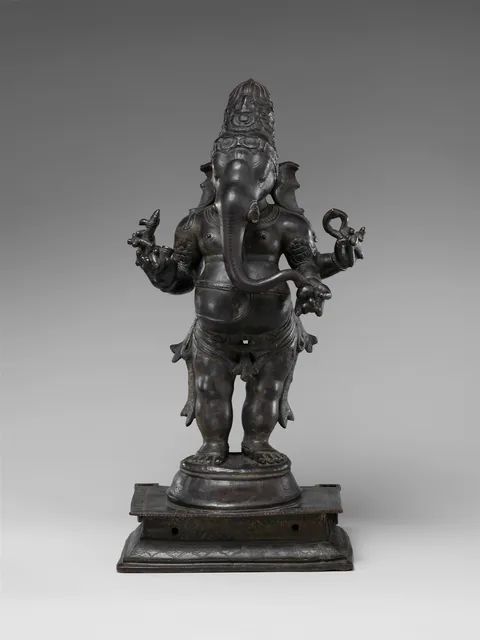
The text next analyses the sound associated with Ganapati: the consonant ga, the vowel a and the nasal element, followed by attention to bindu and nada. It identifies this as Ganesha-vidya and gives the familiar invocation to Ganapati. The following Gayatri-form prayer turns towards knowing, meditating and inspiration. Then the hymn offers a vivid dhyana, or meditation description: Ekadanta, four hands, pasha, ankusha, tusk, boon-giving hand, mouse emblem, red adornment, ample belly and ears like a winnowing basket. The description culminates in compassion towards devotees and the cause of the world. Sound, form and philosophy therefore belong to one composition. The large-scale claim about Brahman has not erased the affectionate image; the image makes focused contemplation possible. When studying, first notice what the Sanskrit names, then discuss what a symbol may suggest. For example, broad ears may prompt reflection on attentive listening, while the text’s own explicit emphasis on compassion should remain central.
Sources: Ganapati Atharvashirsha: Sanskrit text (with separate modern gloss) ↗
The fruits of study and a sustained practice
The closing phalashruti praises the fruits of studying and reciting the hymn, including freedom from obstacles, purification and attainment of dharma, artha, kama and moksha. It also gives ritual contexts and speaks of careful transmission to a disciple. Within the devotional text, these statements express the dignity and transformative promise of the practice. A reader can receive that aspiration while making a modest, sustainable beginning: understand one passage, recite or listen attentively, and return to its meaning. The four aims also broaden the idea of benefit. Dharma concerns right living, artha the resources that support life, kama meaningful desire and enjoyment, and moksha liberation. The hymn’s horizon is thus larger than obtaining one immediate result. Regular study can include both devotion and reflection: what did I understand, what deserves a teacher’s explanation, and how did the pledge of truthful speech influence my day? Such questions keep understanding alive alongside the beauty of sound.
Sources: Ganapati Atharvashirsha: Sanskrit text (with separate modern gloss) ↗
Three worked close-reading practices
Practice 1 — Mark the change from praise to promise. Model answer: the opening addresses Ganapati and makes claims about his reality; the pledge about rta and satya commits the speaker. The change matters because worship includes responsibility for one’s own conduct, rather than only describing the deity’s greatness.
Practice 2 — Draw the people included in the protection prayer. Model answer: place speaker and listener beside one another, with teacher, student and supporters around them. Add two actions: explain patiently and let questions be asked. These actions are our application; the text supplies the widened circle of concern.
Practice 3 — Explain how the hymn can call Ganapati both beyond conditions and compassionately present in form. Model answer: ultimate reality is not exhausted by a passing condition, while the meditation form gives the devotee a beloved focus. The hymn holds the two together, so the reading should follow that connection.
PUT IT INTO PRACTICE
Try three connected practices
- Read a short passage and identify its action: salutation, declaration, pledge, request or meditation.
- Write one truthful sentence about what you know and one honest sentence about what you have not yet understood.
- Choose one name or attribute, explain its textual meaning and add a clearly identified personal reflection.
Check your understanding
Does Brahman mean the same as Brahma?
No. Brahman names ultimate reality in this philosophical context. Brahma is the creator deity, mentioned separately among divine names later in the hymn.
Why are the speaker and listener both protected?
The prayer recognises learning as a shared relation. Knowledge depends on responsible communication, attentive reception and those who sustain them.
Is every popular symbol meaning written in the hymn?
No. It names specific attributes and explicitly praises compassion. Reflections such as broad ears reminding us to listen are useful applications, not quotations from the hymn.
How can a beginner study without rushing?
Follow the sequence, understand a short passage, listen carefully and return to its meaning. A teacher can then help with philosophical vocabulary and recitation.