
The core idea
A material is useful when its electrical, thermal, mechanical and chemical properties fit the job. Element categories provide clues, while structure, alloying and surface protection change practical behaviour.
1. Start with several properties
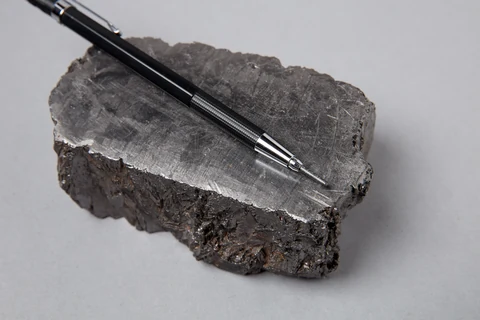
Many metals are lustrous when freshly exposed, conduct electricity and heat, and can be shaped without immediately breaking. Malleability means forming sheets; ductility means drawing wires. These are different from hardness, which concerns resistance to scratching or indentation. A material can be hard yet brittle, or soft yet easily shaped. Generalisations have exceptions: graphite is a non-metal form of carbon that conducts electricity, while mercury is a liquid metal at ordinary room temperature. Neither should be handled as an identification activity. Also distinguish an element from a compound containing it: blue copper sulfate crystals are not copper metal and do not inherit all its properties. Wood, glass and plastics are non-metallic materials, but they are not individual non-metal elements. Classify the actual material before using an element label to explain it.
.jpg)
Sources: NCERT: Metals and Non-metals ↗ · OpenStax, Rice University: The Solid State of Matter ↗
2. Connect properties with internal structure
In a simple model of metallic bonding, positive atomic cores are held together by electrons that can move through the metal. Mobile electrons help explain electrical conduction. Layers of atoms can often shift while metallic bonding continues, helping explain shaping, although real strength also depends on defects, processing and composition. Compare graphite: its carbon atoms form strongly bonded sheets, and some electrons can move within those sheets. Its ability to conduct is therefore an instructive exception to “all non-metals are insulators”. Diamond is also carbon, but its three-dimensional bonding network produces different properties. The chemical element alone is not a complete material specification. Likewise, the stiff appearance of an object does not tell us its conductivity. A structural model should explain a measured property, rather than replace measurement with an attractive drawing.
Sources: OpenStax, Rice University: The Solid State of Matter ↗
3. One object can need opposite properties
Imagine designing a cooking vessel and its handle on paper. The base should transfer heat efficiently, withstand its working temperature, and tolerate its intended food and cleaning conditions. The handle should limit heat reaching the hand while remaining mechanically secure. A conductive base and an insulating handle answer different needs within one object. Similarly, an electrical cable needs a conducting core and a suitable insulating cover; the fact that copper conducts does not make an uncovered wire a useful finished cable. Selection requires a list of conditions, not only a favourite material. Ask about temperature, load, moisture, contact substances, expected life, repair and cost. Appearance alone is insufficient. This is a design comparison, not an instruction to heat samples, test live wires or modify appliances. Use labels, photographs and supplied property information.
Sources: NCERT: Metals and Non-metals ↗
4. A surface layer can protect or fail
Corrosion changes a metal through reactions with its surroundings. Rusting specifically concerns iron and requires water and oxygen under ordinary conditions; silver tarnish and copper patina are different corrosion products. Rust can flake away and expose fresh iron, so it is not a dependable protective cover. Aluminium forms a thin adherent oxide layer that can slow further attack in suitable conditions. Painting iron separates the surface from the surroundings while the coating remains intact. Galvanising adds zinc, which can also protect exposed iron by corroding preferentially when the metals remain appropriately connected. These are different mechanisms: a scratch through paint and a scratch through zinc need not have the same immediate consequence. Protection is still finite, and the environment matters. Observe existing surfaces without scraping, sanding or applying chemicals; record a damaged coating as a maintenance clue.
Sources: OpenStax, Rice University: Corrosion ↗ · NCERT: Metals and Non-metals ↗
5. Worked example: interpret an alloy percentage
An alloy contains a metal combined with other elements to obtain useful properties. Brass contains copper and zinc; steel is based on iron with carbon and possibly other elements. Alloying can change hardness, strength, corrosion resistance and conductivity, but there is no rule that every alloy improves every property. Consider an illustrative brass specification of 70% copper and 30% zinc by mass for a 250 g sample. Copper mass = 0.70 × 250 = 175 g; zinc mass = 0.30 × 250 = 75 g. The check is 175 + 75 = 250 g. This is a composition calculation, not a recipe for melting metals. It does not give a fixed molecular formula for brass. Nor does a percentage alone guarantee performance: processing, microstructure and the intended conditions also matter when choosing a real product.
A 250 g illustrative brass sample
| Component | Mass fraction | Calculation | Mass |
|---|---|---|---|
| Copper | 70% | 0.70 × 250 g | 175 g |
| Zinc | 30% | 0.30 × 250 g | 75 g |
| Total | 100% | 175 g + 75 g | 250 g |
Sources: NCERT: Metals and Non-metals ↗
6. Make a choice that follows from the evidence
Suppose a school display needs a small stand that will remain indoors, carry a light load and be repaired locally. Compare two imaginary options. A costs ₹400 initially and needs a ₹150 repair during the chosen five-year period; B costs ₹650 and needs no repair in that same illustrative record. The recorded totals are ₹550 and ₹650. A costs ₹100 less in this example, but only if both satisfy the load and safety requirements and the assumed repairs are realistic. The calculation cannot prove which unnamed material is stronger, more sustainable or cheaper everywhere. Write a decision with four parts: the job, required properties, evidence and remaining uncertainty. This combines chemistry with fair comparison. Keeping a suitable object in service through maintenance can matter as much as choosing its first material.
PUT IT INTO PRACTICE
Apply your understanding
- For a purely illustrative 400 g alloy containing 75% copper by mass and 25% zinc, calculate both masses.
- Check: copper = 300 g and zinc = 100 g. Explain why this ratio does not tell you the alloy’s exact hardness.
- From a photograph of a pan, list one required property of the base and one of the handle. No heating or electrical test is needed.
Check your understanding
Is hardness the same as malleability?
No. Hardness concerns indentation or scratching; malleability concerns forming sheets without breaking.
Why is graphite a useful counterexample?
It is a non-metal form of carbon that conducts electricity, so category alone is insufficient.
Why can damaged paint matter?
It can expose iron to water and oxygen, permitting rust to develop.
Does brass have one fixed molecular formula?
No. Brass is an alloy with variable composition, rather than a substance built from identical brass molecules.