
The core idea
Acids and bases change the balance of hydronium and hydroxide ions in water. Indicators reveal part of that change; pH describes acidity, not identity, purity or overall safety.
1. Acidity is about the solution
Water contains mostly H₂O molecules, with very small amounts of hydronium, H₃O⁺, and hydroxide, OH⁻, ions. An acid increases the hydronium concentration in water; a base can increase hydroxide concentration. A soluble base is called an alkali. At a deeper level, many acid–base reactions transfer a proton: an acid donates it and a base accepts it. These descriptions connect visible behaviour to invisible particles. They also explain why merely finding hydrogen in a formula does not identify an acid: glucose contains hydrogen but does not behave like hydrochloric acid in water. The word acidic describes a measured chemical condition. It does not mean every acidic material is equally concentrated or equally hazardous. Keep the substance, its amount, and its aqueous solution distinct when explaining an observation.

Sources: NCERT: Acids, Bases and Salts ↗ · OpenStax, Rice University: Brønsted–Lowry Acids and Bases ↗
2. An indicator has a particular job
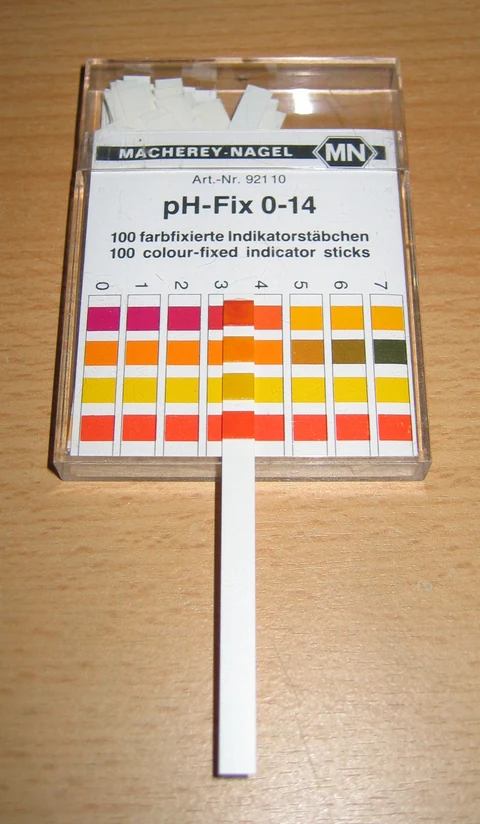
Blue litmus turns red in an acidic solution, while red litmus turns blue in a basic solution. Red litmus remaining red does not by itself distinguish an acid from a neutral solution. The useful comparison therefore uses both colours or another suitable indicator. Turmeric can show a reddish-brown change in basic conditions, but yellow turmeric does not separate every acidic sample from every neutral one. Universal indicator combines several dyes and gives an approximate pH range when compared with its own chart. Read the result in similar lighting and record the original colour of the sample: a strongly coloured liquid may hide the change. An indicator is a chemical tool with limits, not a universal identity test. This lesson uses supplied records and pictures; do not taste, touch or smell samples to classify them.
Sources: NCERT: Acids, Bases and Salts ↗ · American Chemical Society: pH and Color Change ↗
3. A small pH difference can be a large ratio
For dilute aqueous solutions, pH provides a logarithmic description of hydronium concentration. At 25 °C, neutral water has pH 7; acidic solutions have lower values and basic solutions higher values. Neutral means equal hydronium and hydroxide concentrations, not an absence of ions. The neutral value depends on temperature. The familiar 0–14 diagram is useful for school examples, but it is not an absolute boundary for all solutions. In a simplified comparison, pH 3 corresponds to 10⁻³ mol/L hydronium and pH 5 to 10⁻⁵ mol/L. The ratio is 10⁻³ ÷ 10⁻⁵ = 100, so the first has about 100 times the hydronium concentration. Do not say it has “two times the acidity” because the pH numbers differ by two. The ratio does not describe every aspect of chemical behaviour.
pH steps multiply, rather than add
| pH at 25 °C | Approximate H₃O⁺ concentration | Compared with pH 5 | Classification |
|---|---|---|---|
| 3 | 10⁻³ mol/L | 100 × | Acidic |
| 5 | 10⁻⁵ mol/L | 1 × | Acidic |
| 7 | 10⁻⁷ mol/L | 0.01 × | Neutral |
4. Strength and concentration answer different questions
Concentration describes how much dissolved substance is present in a stated volume. Acid strength describes how extensively an acid reacts with water to produce ions under specified conditions. A strong acid is extensively ionised in dilute water; a weak acid is only partly ionised. Weak therefore does not mean harmless, and dilute does not mean weak. Imagine two labelled information cards: one says “a small amount of a strong acid in much water”; another says “much weak acid in a little water”. The words alone cannot rank their pH because both identity and concentration matter. A pH reading also does not tell us the total amount of acid available to react. Use the precise phrase “lower measured pH” when that is all the evidence establishes. Never use an indicator result as permission to handle an unknown liquid.
Sources: OpenStax, Rice University: Relative Strengths of Acids and Bases ↗
5. Neutralisation is not a safety certificate
For a simple acid reacting with a hydroxide base, hydronium and hydroxide form water; the other ions can remain in solution as a salt. Equal volumes need not supply equal reacting amounts. Even after reaction, excess acid or base can remain, and some salts themselves affect pH. Consider a paper model with 12 acid-equivalent counters and 9 base-equivalent counters, each counter representing the same reacting amount. Nine pairs cancel, leaving 3 acid-equivalent counters: one quarter of the initial acid amount remains. This bookkeeping predicts an excess, not a numerical pH. A neutral pH would still not identify other dissolved substances or establish drinking safety. Treat this as reasoning on paper. Do not mix cleaning products, medicines or unknown liquids, or attempt household neutralisation of a spill.
Sources: American Chemical Society: Neutralizing Acids and Bases ↗ · NCERT: Acids, Bases and Salts ↗
6. Separate observation, inference and uncertainty
An illustrative worksheet records three samples: A turns blue litmus red; B turns red litmus blue; C changes neither strip. A supports “acidic”, B supports “basic”, and C is consistent with neutral under this test, but weak changes or an unsuitable strip could be missed. Now add supplied meter readings at 25 °C: A = 4.0, B = 9.0, C = 7.0. These reinforce the classifications if the meter was checked and used properly. They still do not identify the liquids. A careful report names the method, temperature, result and limitation. If a colour lies between two chart patches, report an approximate range instead of inventing decimal precision. Our practical skill is judging the evidence we have and recognising the additional evidence a stronger conclusion would require.
Sources: American Chemical Society: pH and Color Change ↗ · OpenStax, Rice University: pH and pOH ↗
PUT IT INTO PRACTICE
Apply your understanding
- Use only the supplied data: P has pH 4 and Q has pH 6 at 25 °C. Classify each and calculate the approximate hydronium ratio.
- Check: both are acidic; P has about 100 times Q’s hydronium concentration. This does not identify P or Q.
- Write one claim that the readings support and one they cannot support. No material handling or mixing is required.
Check your understanding
Does unchanged red litmus prove a solution is neutral?
No. An acidic solution also leaves red litmus red. Use additional evidence.
How does pH 5 compare with pH 6?
In the dilute-solution approximation, pH 5 has ten times the hydronium concentration.
Are weak acid and dilute acid synonyms?
No. Strength concerns ionisation; concentration concerns amount per volume.
Can pH 7 certify drinking safety?
No. It says nothing sufficient about microbes or other dissolved contaminants.