
The core idea
Vivekananda connected a Vedantic understanding of the Self with disciplined learning, religious acceptance and organised service. His work joined spiritual apprenticeship, international teaching and the creation of lasting institutions.
Narendra’s questions and a teacher’s influence
Swami Vivekananda was born Narendra Nath Datta in Kolkata on 12 January 1863. His studies included Western philosophy, while music and meditation also interested him. In November 1881, he met Sri Ramakrishna at a devotee’s house, where he had been invited to sing. Further visits made him Ramakrishna’s disciple. In My Master, Vivekananda recalls asking whether his teacher could establish the reality of God. Ramakrishna answered from his claimed direct experience, and Narendra returned repeatedly to learn from him. This encounter placed spiritual realisation at the centre of his religious search. After Ramakrishna’s death in 1886, he helped lead the young disciples’ monastic brotherhood at Baranagar. The later public teacher thus emerged through questioning, personal apprenticeship and a demanding shared life.
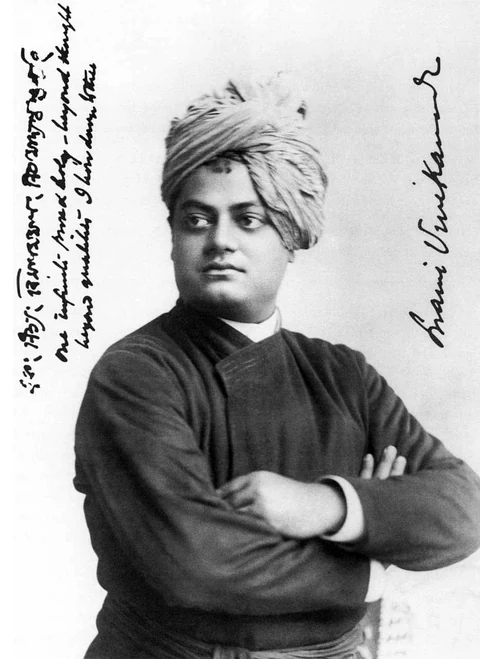

Sources: Belur Math: Swami Vivekananda — official biography ↗ · Swami Nikhilananda: Vivekananda, Early Years — biography mirror ↗ · Vivekananda: My Master — primary lectures from 1896 ↗
From an Indian journey to international teaching
As a wandering monk, Vivekananda travelled across India before addressing audiences abroad. In December 1892 he meditated on the rock off Kanyakumari, now commemorated by the memorial there. His international journey began from Bombay in May 1893. He travelled east through Asian ports to Japan, crossed the Pacific to Vancouver, and continued by train towards Chicago. This route connected his Indian formation with a wider world of religious exchange. The Parliament of Religions brought him international recognition in September. His work then expanded into sustained teaching in the United States and England: the London lecture on Practical Vedanta in November 1896 shows him developing arguments beyond the short Parliament speeches. He returned to India in January 1897 with a public teaching career that now linked audiences on several continents.
From public teaching to organised service
| Date | Milestone | Learning connection |
|---|---|---|
| 11 September 1893 | Response to Welcome, Chicago | Religious acceptance |
| 10 November 1896 | Practical Vedanta I, London | Spiritual ideals in daily work |
| 1 May 1897 | Mission Association inaugurated, Kolkata | A lasting organisation |
Sources: Belur Math: Swami Vivekananda — official biography ↗ · Kanniyakumari District: Vivekananda Rock Memorial ↗ · Lalita Kaplish, Wellcome Collection: Vivekananda’s journey (2018) ↗ · Vivekananda: Response to Welcome, Chicago, 11 September 1893 — primary-text mirror ↗ · Vivekananda: Practical Vedanta, Part I, London, 10 November 1896 — primary-text mirror ↗
What the Chicago welcome actually teaches
In the Response to Welcome on 11 September 1893, Vivekananda addressed his listeners as sisters and brothers. He presented a Hindu affirmation of religious acceptance, used the image of different streams reaching the sea, and condemned persecution and fanaticism. The argument moves from relationship to principle and then to conduct: welcoming another person should alter how people treat religious difference. His language expresses his own expansive interpretation of Hindu tradition. It does not establish that every Hindu school, or every participant in another religion, understands truth in precisely the same way. Read the speech as a powerful intervention in interreligious encounter. Its demand for generosity remains meaningful even when difficult theological disagreements still require careful discussion.
Sources: Vivekananda: Response to Welcome, Chicago, 11 September 1893 — primary-text mirror ↗
Worked example: confidence after a setback
Practical Vedanta, Part I, delivered in London on 10 November 1896, grounds confidence in the spiritual nature of the Self. Vivekananda’s language of unlimited power is philosophical encouragement, not a guarantee of health or ability without training. Consider a learner who fails a mathematics test and concludes, “I am worthless.” First separate personal dignity from this result. Next identify the missed skill: perhaps converting fractions. Practise three problems with guidance, check errors, and try again. The learner now has a specific task instead of a judgment condemning the whole person. Asking a teacher for help becomes compatible with confidence. In this application, the ideal of strength encourages patient work: recognise difficulty, accept instruction, and build competence through repeated effort.
Sources: Vivekananda: Practical Vedanta, Part I, London, 10 November 1896 — primary-text mirror ↗
Active work and a steady mind
The same lecture rejects the idea that spirituality must retreat from ordinary activity. Vivekananda draws attention to teaching associated with rulers and to the Bhagavad Gita’s battlefield setting. His central practical contrast is between purposeful work and energy scattered by anger, vanity or resentment. Calmness here supports action; it is not indifference to another person’s suffering. For a learner, the distinction is concrete: recognising a mistake, correcting it and continuing differs from spending the whole session defending one’s reputation. A steady response still allows firm disagreement and correction of unfair treatment. The spiritual ideal asks for a transformation of motivation and attention, rather than simply giving familiar habits a religious name.
Sources: Vivekananda: Practical Vedanta, Part I, London, 10 November 1896 — primary-text mirror ↗
Worked example: knowledge that becomes conduct
In The Future of India, a lecture collected in the 1897 Colombo-to-Almora series, Vivekananda criticises education reduced to undigested information. He asks for ideas that shape character and life. A classroom example makes the distinction clear. Two learners memorise a definition of honesty. One repeats it accurately but hides a borrowed book after damaging it. The other reports the damage, apologises and agrees on repair. Both may possess verbal knowledge; the second shows a beginning of assimilation. The lesson is not that facts or books are useless. Accurate knowledge supplies material for judgment, while practice tests whether the learner can use it. A useful study session therefore includes recall, explanation, application and reflection on the result.
Sources: Vivekananda: The Future of India, Lectures from Colombo to Almora (1897) — primary-text mirror ↗
Why building an institution mattered
His return produced concrete institutions as well as lectures. In 1897 he spent nine days at the Chennai building now called Vivekananda House; the Ramakrishna Math in Chennai subsequently functioned there from 1897 to 1906. On 1 May 1897, he inaugurated the Ramakrishna Mission Association at Balaram Bose’s house in Kolkata. An organisation gave shared intentions a continuing form beyond the presence of one speaker. Service needs people who learn, coordinate and undertake dependable work. A school needs regular teaching; relief work needs attention to actual needs; shared resources require responsibility. Vivekananda’s institutional work therefore joined his philosophical emphasis on human dignity to a practical question: how can spiritual commitment become sustained help through a community of workers?
Sources: Sri Ramakrishna Math, Chennai: Vivekananda House ↗ · Belur Math: Balaram Mandir and the Mission’s inauguration on 1 May 1897 ↗ · Vivekananda: Practical Vedanta, Part I, London, 10 November 1896 — primary-text mirror ↗
Worked example: agreement without erasing difference
Imagine a reading group in which one learner worships a personal deity and another studies an impersonal understanding of Brahman. A careless summary says their views are identical. A hostile response says conversation is impossible. A better process has three steps: each explains a view in terms the other accepts; both identify a shared practical commitment, such as truthful speech; each records the remaining philosophical difference. This example draws on Vivekananda’s calls for acceptance and cooperation. It does not turn cooperation into proof of doctrinal agreement. His own Vedantic synthesis is an influential position to study, alongside other Hindu interpretations that give different accounts of God, the world and liberation.
Sources: Vivekananda: Response to Welcome, Chicago, 11 September 1893 — primary-text mirror ↗ · Vivekananda: The Future of India, Lectures from Colombo to Almora (1897) — primary-text mirror ↗
Belur Math and a continuing legacy
Early in 1898, Vivekananda acquired land at Belur on the western bank of the Ganga for a permanent monastery. Belur Math gave the brotherhood that had begun at Baranagar an enduring home. His work also took durable literary forms: lectures, letters and books carried arguments to readers who had never heard him speak. He trained disciples and helped establish institutions through which teaching could continue. These activities show several sides of one career: the apprentice of Ramakrishna, the travelling monk, the public interpreter of Vedanta and the organiser. Vivekananda died on 4 July 1902 at Belur Math, where his memorial stands. His legacy connects reflection on the Self with character, religious encounter and organised service.
Sources: Belur Math: Swami Vivekananda — official biography ↗ · Belur Math: About Swami Vivekananda — 150th birth anniversary ↗ · Belur Math: Swami Vivekananda Temple ↗
PUT IT INTO PRACTICE
Practise reading and applying an idea
- Read one section of Practical Vedanta and record its claim, reason and intended change in conduct.
- Choose a study difficulty; name one skill, one source of help and one realistic next action.
- Plan a small act of service and ask the person concerned what would actually help.
Check your understanding
When and where did Vivekananda give the Response to Welcome?
At the Parliament of Religions in Chicago on 11 September 1893.
Does spiritual confidence guarantee success or health?
No. His exhortation concerns the Self and courageous effort; practical learning still requires skills, help and realistic attention to circumstances.
How does assimilation differ from memorisation?
Memorisation can reproduce information; assimilation also changes understanding, judgment and conduct. Accurate recall remains useful.
Does religious acceptance mean all doctrines are identical?
No. Respect and cooperation can coexist with clearly explained differences in theology and philosophy.