
A closed loop
Choose the switch position that completes the loop and lights the bulb.
Try the activity →A PLS FOUNDATION PROGRAMME
Free science and engineering learning for India. Begin with electricity, ask a question, and try a small experiment on screen.
QUANTUM SHARMA · FOLLOW YOUR CURIOSITY
Follow quartz to silicon, then open the CPU, GPU, memory, storage or solar-cell branch. Read the explanation, try a small model and keep building your understanding.
Try the working models → Learn the foundations →
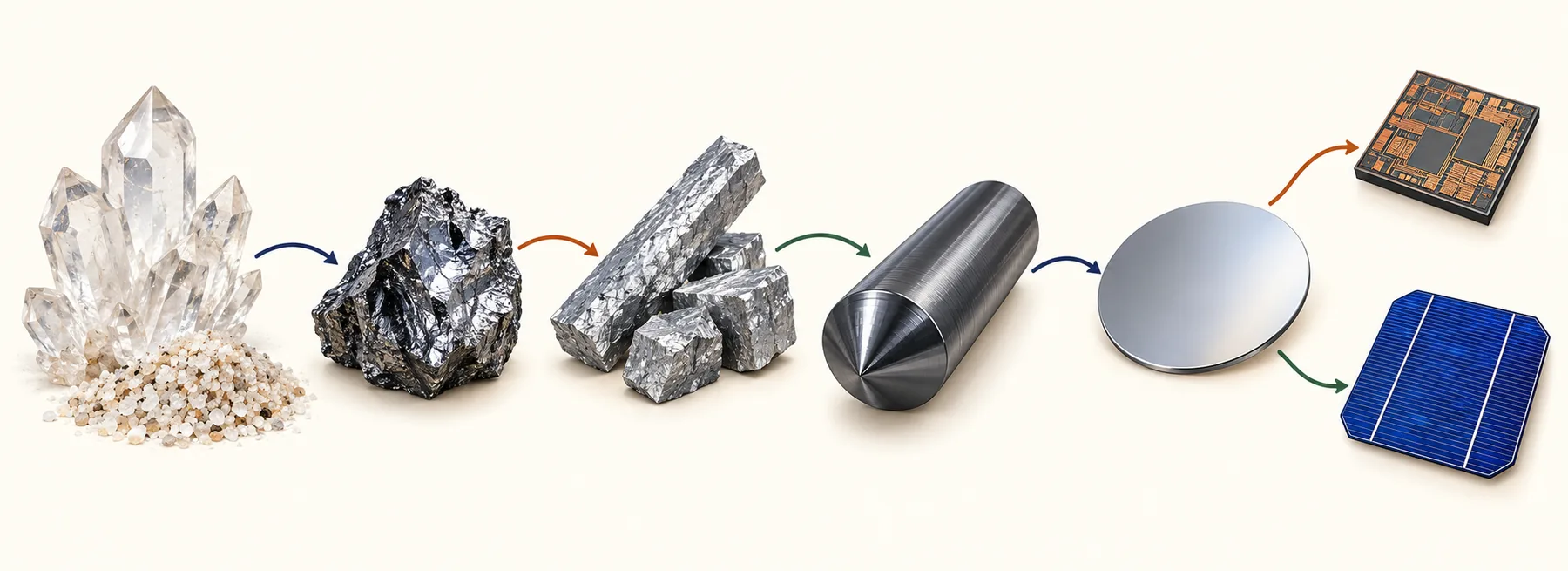
Explore the full silicon tree → Build and test logic → All Quantum Sharma learning →
TEXT, NUMBERS AND PREDICTIONS
Follow text through token pieces, vocabulary IDs, vectors, context and probabilities. Inspect a small attention calculation, then train a tiny count model on example sentences and generate one token at a time.
Open the AI Language Lab →WATCH AN IDEA WORK
Switch an ideal CMOS inverter, explore eight-bit addition, and step through a tiny CPU program. Predict a result, change one thing and explain what happened. Read the connected guides on atoms, transistors, binary numbers and instructions.
Open Working Models →FREE · ENGLISH & HINDI · NO ACCOUNT
Play four short electricity lessons: complete a loop, use Ohm’s law, compare series and parallel connections, and choose an LED resistor. Start with concepts familiar from classes 6–8; learn at your own pace.
Open the free activity →Choose the switch position that completes the loop and lights the bulb.
Try the activity →Choose a resistance that gives 0.30 A at 6 V.
Try the activity →Give each bulb the full 6 V.
Try the activity →Choose a resistor for an LED current between 10 and 15 mA.
Try the activity →PHASE 2 · BUILD DIGITAL LOGIC
Move from switches to bits. Build NOT, AND, OR, XOR, NAND and NOR gates, then combine them into a selector and a half adder. Test every input combination. Free build lets you create your own small logic algorithms and export JSON or Verilog.
Open Logic Lab →Learn what an oligopoly is, who supplies the different parts of the semiconductor ecosystem, and how a verified logic design can progress toward an integrated circuit. Follow practical exercises and original-source reading.
Read all engineering guides →Quantum Sharma connects playable electricity and digital logic with the Foundation’s existing science and physics library. Start with the four electricity lessons, then build and verify your own gate networks.
Explore semiconductors and integrated circuits (ICs) in the Silicon Atlas today. The working models connect device ideas to small calculations and programs. Later phases will add deeper design tools and quantum science. The current builder verifies ideal Boolean logic; transistor-level electrical simulation, physical layout and fabrication services remain future work.
Explain current, voltage and resistance with worked examples and practice.
Learn more →Connect your circuit questions to the existing physics lessons.
Learn more →Read about matter, living things, energy and scientific evidence.
Learn more →