
The core idea
His contribution includes Bengali literature, the internationally recognised English Gitanjali, and educational institutions that gave nature, the arts and cultural exchange an important place.

1. A writer in a changing Bengal
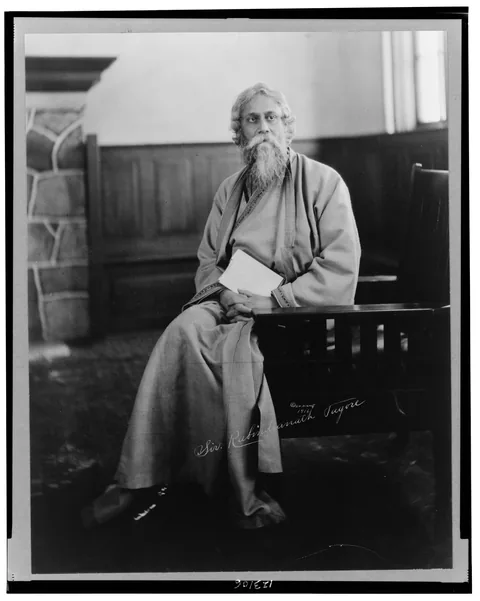
Rabindranath Tagore lived from 1861 to 1941. He grew up in Bengal under British colonial rule, when questions about language, education, social reform and political freedom were intensely debated. His family’s cultural resources gave him opportunities unavailable to many others. Recognising that setting helps us understand how artistic work becomes possible without explaining creativity as privilege alone.
Tagore worked in poetry, stories, drama, songs and essays, and later in painting. These forms ask different things of a reader or viewer: a story can follow a difficult choice, while a lyric can concentrate an emotion into sound and image. His public importance cannot be reduced to a single prize or a list of celebrated titles.
Sources: Nobel Prize: Rabindranath Tagore, biographical account ↗
2. Literature crossing languages
The Bengali Gitanjali appeared in 1910; the English Gitanjali, or Song Offerings, appeared in 1912. The English volume contains Tagore’s translations selected from more than one Bengali collection. It is therefore misleading to imagine that the two books match page for page. In 1913 he received the Nobel Prize in Literature. That recognition widened the audience, but it does not make English the original language of all his work.
Translation requires decisions about rhythm, meaning, image and cultural references. A reader comparing versions should ask what is preserved, what changes and why. Neither a literal word substitution nor an attractive new sentence automatically captures the original. This makes translation an act of interpretation as well as communication.
Sources: Nobel Prize: Rabindranath Tagore, biographical account ↗ · Tagore: Gitanjali, English text, poem 35 ↗
3. Learning through attention and activity
Tagore began his school at Santiniketan in 1901. Its open-air classes and place for music, painting and performance challenged a narrow understanding of education as memorising answers. His educational thinking valued children’s language, sensory experience and active participation. The learner was someone who could notice, make, discuss and revise.
Consider the mechanism. Naming a leaf from a list tests recall; comparing two leaves and explaining a classification also tests observation and reasoning. Drawing can make unnoticed details visible. Discussion exposes a mistaken assumption. Such activities still need clear purposes, guidance and feedback. Freedom to explore does not mean that every answer is equally supported or that teachers have no responsibilities.
Sources: Visva-Bharati: history of the school ↗ · Visva-Bharati: educational ideas ↗
4. Institutions and public responsibility
Visva-Bharati developed as a meeting place for learning across cultures. At Sriniketan, the Institute of Rural Reconstruction was established in 1922, with Leonard Elmhirst as its first director. Education there was connected with rural life and practical inquiry. This institutional work involved colleagues, teachers and communities; crediting Tagore’s vision should not erase their labour.
In 1919 Tagore renounced his knighthood in protest after the Jallianwala Bagh massacre. A state honour can give prestige, yet its recipient can judge that accepting it conflicts with public conscience. This action matters as a documented political choice. It does not turn every poem into a political manifesto or settle every disagreement about his ideas.
Sources: Visva-Bharati: educational ideas ↗ · Visva-Bharati: Institute of Rural Reconstruction ↗ · UK Parliament: Tagore and knighthood, 31 July 1919 ↗ · Government of India: Tagore anniversary and public legacy ↗
5. A timeline with different kinds of work
Place these milestones in order: 1861, birth; 1901, the Santiniketan school; 1910, Bengali Gitanjali; 1912, English Gitanjali; 1913, the Nobel Prize; 1919, rejection of the knighthood; 1922, the Sriniketan institute; 1941, death. Notice that the school preceded the prize by twelve years. Educational work was not simply an activity added after international fame.
A timeline establishes sequence, not a complete explanation of causes. A book’s publication, a political protest and an institution’s opening require different evidence. To explain a change, add the relevant text, correspondence or institutional record instead of drawing a causal arrow just because two dates are close.
A life in milestones
- 1861Birth
- 1901Santiniketan school
- 1910Bengali Gitanjali
- 1912English Gitanjali
- 1913Nobel Prize in Literature
- 1919Knighthood renounced
- 1922Sriniketan institute
- 1941Death
Sources: Nobel Prize: Rabindranath Tagore, biographical account ↗ · Visva-Bharati: history of the school ↗ · Visva-Bharati: Institute of Rural Reconstruction ↗ · Government of India: Tagore anniversary and public legacy ↗
6. Worked learning case: interpreting an image
In poem 35 of the English Gitanjali, Tagore connects fearless thought, accessible knowledge and truthfulness, and contrasts flowing reason with lifeless habit. Suppose a reader concludes that the poem merely asks people to memorise more facts. Test that interpretation against the poem’s relationships: thought should keep moving, while rigid habit can obstruct it. A stronger reading is that learning requires intellectual courage and active judgement.
This is a reasoned interpretation, not a claim that only one reading is possible. Explain the textual connection rather than announcing that you like the poem. Also separate aspiration from description: a poem imagining a freer country is not evidence that everyone in its historical society already enjoyed that freedom.
7. Worked learning case: design an integrated lesson
Imagine a youth group studying a familiar tree. This is an original teaching example, not a reconstruction of Tagore’s classroom. Learners first record visible leaf shapes without removing leaves. They then draw one feature and write two sentences describing how the place feels. Finally, they label which statements are observations and which express impressions. “The leaf has a toothed edge” needs visual evidence; “the shade feels welcoming” expresses an experience.
The check is whether learners can justify that distinction and improve an unclear description. Art and inquiry contribute different kinds of understanding; combining them should strengthen both. A pleasant activity becomes a lesson when learners can explain what they noticed and how their thinking changed.
Sources: Visva-Bharati: educational ideas ↗ · Visva-Bharati: history of the school ↗
PUT IT INTO PRACTICE
Apply the lesson and check your reasoning
- Put the school, the two Gitanjali editions and the Nobel Prize on a timeline, naming the event beside each year.
- Write one interpretation of poem 35 using the relationship between reason and habit.
- Design a brief observation-and-writing activity using an ordinary object, and label an observation and an impression.
- Check: the order is 1901, 1910, 1912, 1913. Your interpretation needs textual support; your observation needs evidence; your impression should be identified as personal response.
Check your understanding
Are the Bengali and English Gitanjali identical books?
No. The English selection draws from several Bengali collections. Language and selection both matter when identifying a work.
Does creative learning remove standards?
No. Observations still require evidence and interpretations require reasons. Freedom creates room to explore and revise.
Why include the school before the prize?
Chronology shows that education was an established commitment, not merely a later consequence of literary fame.
Can a poem prove a historical condition?
It can reveal an expressed viewpoint or aspiration. Claims about how widely a condition existed require additional evidence.
Why remember institutional colleagues?
A founding idea needs teaching, administration, research and community participation. Institutions are sustained by many people.