
The core idea
Her contribution joined girls’ education with opposition to caste and gender inequality. She worked with Jyotirao Phule and a wider network, while taking an active teaching and intellectual role herself.
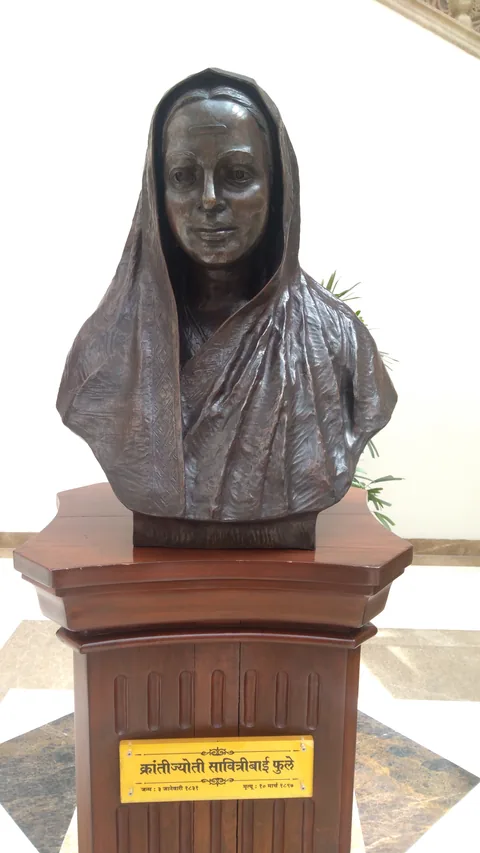

1. The barriers education had to cross
Savitribai was born in 1831 in Naigaon, in present-day Maharashtra. Nineteenth-century western India was shaped by colonial rule and unequal social relations. Opportunities to learn were strongly affected by gender, caste and resources. Caste discrimination assigned status through inherited social categories and could deny people access to common institutions. These restrictions were imposed by society; they did not measure anyone’s capacity to learn. Reform took place amid argument: different communities, teachers and writers disagreed about education and authority. Avoid imagining a society in which everybody held one opinion. Savitribai’s work mattered because it challenged exclusions through an institution that could be used every day.
Sources: NCERT on IIT Kanpur SATHEE: Women, Caste and Reform ↗ · NCERT: Women in Indian History — Savitribai Phule ↗
2. A teacher who helped build schools
In 1848, Savitribai and Jyotirao Phule began a school for girls in Pune. She learned, trained as a teacher and took responsibility for teaching and school leadership. This was skilled work, not simply a symbolic appearance beside a reformer. Planning lessons, helping learners practise and keeping a school functioning require repeated decisions. Their educational work faced opposition and depended on supporters as well as their own labour. The NCERT memorial volume discusses school reports and other records, allowing us to see organised activity rather than only later praise. A careful biography therefore credits Savitribai’s agency while recognising that pupils, families, colleagues and supporters also made schooling possible.
Sources: NCERT: Savitribai Phule First Memorial Lecture ↗ · NCERT: Women in Indian History — Savitribai Phule ↗
3. Why teaching can change the distribution of power
Consider what literacy enables: reading a notice independently, checking an account, comparing an argument or writing a request. When only a restricted group can do these things, other people must depend on intermediaries. Expanding education can reduce that dependence. This explains the connection between teaching and equality without claiming that literacy alone removes every injustice. A learner also needs time, materials, an understandable language and respectful treatment. Opening a school changes one barrier; enabling participation addresses several more. Savitribai’s educational work helps us ask a precise question of an institution: who can actually use the opportunity it announces, and what must change for those still excluded?
Sources: NCERT: Women in Indian History — Savitribai Phule ↗ · NCERT on IIT Kanpur SATHEE: Women, Caste and Reform ↗
4. Read her as a writer as well as an educator
Her poetry collection Kavya Phule appeared in 1854. The poems reproduced in the NCERT memorial publication connect knowledge with self-reliance and question social hierarchy. Writing gave her another way to address a public beyond a particular classroom. A poem persuades through rhythm, images and emphasis; a school report records a different kind of evidence. Neither should be mistaken for the other. When reading a reform poem, ask what it urges its audience to do, which injustice it identifies and how its language creates urgency. A translated poem also passes through a translator’s choices. Discuss its argument carefully rather than inventing a memorable quotation and attaching her name to it.
5. A timeline of sustained work
Use these milestones as anchors: 1831, birth; 1848, the Pune girls’ school; 1854, Kavya Phule; 1897, the end of her life. The school and the poetry collection were six years apart. Teaching and public writing could reinforce one another during this period. Her wider work also included care for people excluded or made vulnerable by social conditions. These milestones do not describe every year or prove that progress was uninterrupted. A timeline orders evidence; it does not explain causes by itself. To understand change, connect each date with a practice, the people involved and the barrier being addressed. Her influence should be studied through that work, not only commemorative titles.
A life in milestones
- 1831Birth
- 1848Pune girls’ school
- 1854Kavya Phule
- 1897Death
Sources: NCERT: Women in Indian History — Savitribai Phule ↗ · NCERT: Savitribai Phule First Memorial Lecture ↗
6. Worked learning case: an open door is only a start
Hypothetical case, not a record of Phule’s schools: a free reading class enrols 20 learners, but only 14 attend regularly. The regular-attendance fraction is 14/20 = 70%. An organiser concludes that the other learners lack interest. That conclusion goes beyond the evidence. Attendance may be affected by timing, travel or inaccessible materials. A stronger response first asks about practical barriers without blaming individuals, then adjusts one condition and checks again. Enrolment shows permission to enter; attendance shows participation; a reading task provides evidence of learning. These measures answer different questions. Even if attendance rises, the organiser must still check whether learners understand what they read and feel able to ask for help.
Sources: NCERT: Women in Indian History — Savitribai Phule ↗ · NCERT on IIT Kanpur SATHEE: Women, Caste and Reform ↗
7. Worked learning case: make a defensible historical claim
Imagine two statements for a school exhibition: “One person ended educational inequality” and “Savitribai helped build institutions that challenged exclusion.” The first claims a complete result across society and would require evidence far beyond one biography. The second names a documented kind of work and leaves room for collaboration and unfinished change. Now pair a dated school record with a poem: the record supports a claim about institutional activity, while the poem supports an interpretation of the writer’s aims. Neither alone measures long-term learning for an entire population. The stronger exhibit explains what each source can show, states what remains uncertain and gives the learner an active contribution rather than a flawless legend.
Sources: NCERT: Savitribai Phule First Memorial Lecture ↗ · NCERT: Women in Indian History — Savitribai Phule ↗
PUT IT INTO PRACTICE
Apply the lesson and check your reasoning
- Write the four timeline anchors and one action attached to each. Keep a date separate from your interpretation of its importance.
- In the hypothetical class, calculate how many enrolled learners are not regular attendees. Suggest two possible barriers without assuming either has been proved.
- Design one practical change and one way to check both participation and learning. Use invented, anonymous records rather than collecting personal details.
- Check: 20 − 14 = 6 learners; the attendance figure alone cannot explain why. A sound answer links a proposed change to a barrier and uses a separate reading task to check learning.
Check your understanding
Why is her teaching role important in its own right?
It involved knowledge, preparation and institutional responsibility. Calling her only a supporter hides work that made educational access practical.
Why can free admission still leave learners excluded?
Fees are only one barrier. Time, travel, language, materials and treatment may still prevent meaningful participation.
Does a poem prove how many learners attended a school?
No. It can reveal arguments and aspirations, while attendance requires suitable records. Sources have different evidential uses.
Why should a biography name collective effort?
Institutions depend on teachers, learners and supporters. Recognising them makes the account more accurate without diminishing Savitribai’s contribution.
What does the six-year gap between 1848 and 1854 tell us?
It orders the school and publication milestones. It does not by itself explain why either happened or prove that one caused the other.