
The core idea
As a scholar, anti-caste leader, lawyer and chair of the Constitution’s Drafting Committee, he helped turn demands for equality into public arguments and institutional safeguards. Constitution-making remained a collective process.
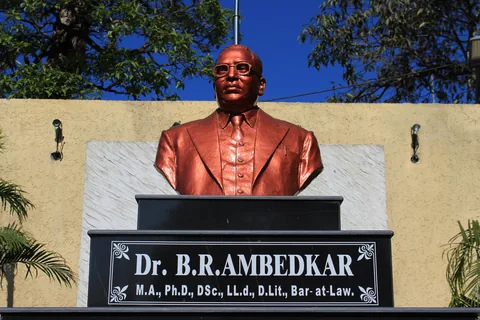

1. Learning within an unequal social order
Ambedkar was born on 14 April 1891 in Mhow, now in Madhya Pradesh. He grew up within a caste order that subjected Dalits to exclusion and practices of untouchability. His experience was part of a wider system, not simply a series of unfriendly encounters. Such a system could restrict access to education, public resources and social respect. Colonial government did not make these inequalities disappear. Understanding this context explains why Ambedkar treated education and civic equality as connected questions. His later achievements do not prove that discrimination was harmless or that every excluded person could overcome it through effort alone. They show the work of a person who also challenged the barriers themselves.
Sources: Supreme Court of India: Ambedkar’s legal and public career ↗
2. Scholarship became a tool of public argument
In 1913, a scholarship enabled Ambedkar to study at Columbia University. He studied economics and engaged with wider social and political ideas; Columbia awarded his economics doctorate in 1927. He also pursued legal and economic studies in London. These fields offered different tools: economics asks how resources and institutions work, while law examines authority, obligations and enforceable claims. In 1936 he published Annihilation of Caste after the planned address was not delivered to the inviting organisation. It challenged caste hierarchy as a structure requiring fundamental change. The important link is not a list of degrees: research helped him examine assumptions, formulate arguments and address audiences who disagreed with him.
Sources: Columbia University: Bhimrao Ramji Ambedkar ↗ · Supreme Court of India: Ambedkar’s legal and public career ↗
3. From public access to constitutional safeguards
In 1927, Ambedkar led the Mahad movement asserting equal access to public water. The issue was more than thirst: exclusion from a shared resource marked some people as unequal members of society. Later, as chair of the Drafting Committee, he had a central role in shaping and explaining the constitutional text. Article 17 abolishes untouchability. More broadly, constitutional rights place limits on how public power may be used. A right also needs a remedy: some recognised way to challenge a violation. Ambedkar emphasised the importance of constitutional remedies in the Assembly. The distinction is practical: a promise says what should happen; an enforceable safeguard provides a route for contesting what goes wrong.
Sources: Supreme Court of India: Ambedkar’s legal and public career ↗ · PIB: Constitution — fundamental rights ↗ · Supreme Court of India: Ambedkar’s Constituent Assembly speeches ↗
4. Democracy extends beyond counting votes
In his speech on 25 November 1949, Ambedkar connected political democracy with social democracy and brought liberty, equality and fraternity into one argument. Liberty protects room for thought and action; equality rejects inherited superiority; fraternity asks people to recognise one another as fellow members of a common society. These are explanatory descriptions, not quotations. Elections cannot by themselves ensure that everyday relationships respect those principles. He also warned that a constitution’s working depends on those who operate it. This does not make written rules unimportant. It means institutional design and public conduct must support each other. A democratic institution needs procedures for disagreement, reasons for decisions and protection against arbitrary exclusion.
Sources: Supreme Court of India: Ambedkar’s Constituent Assembly speeches ↗
5. Read the milestones as a connected sequence
Timeline: 1891, birth; 1913, studies at Columbia begin; 1927, Mahad action and the Columbia doctorate; 1936, Annihilation of Caste; 1947, Drafting Committee leadership; 26 November 1949, the Constitution is adopted; 26 January 1950, it comes into force; 1956, his death. Adoption and commencement are different events. The text emerged through committees, debate, revision and the Constituent Assembly’s decisions, not solitary authorship. Ambedkar’s leadership deserves precise recognition within that collective work. His disagreements with other leaders also belong to the history: respectful study can examine arguments and compromises without pretending that everybody shared the same programme or that independence instantly completed social equality.
A life in milestones
- 1891Birth
- 1913Columbia studies begin
- 1927Mahad action; Columbia doctorate
- 1936Annihilation of Caste
- 1947Drafting Committee leadership
- 194926 November: Constitution adopted
- 195026 January: Constitution in force
- 1956Death
Sources: Supreme Court of India: Ambedkar’s legal and public career ↗ · Columbia University: Bhimrao Ramji Ambedkar ↗ · Parliament Digital Library: Constituent Assembly debates ↗ · Press Information Bureau: The Journey of India as a Republic, constitutional dates ↗
6. Worked learning case: a majority and a right
Hypothetical school-library case: a majority votes to allow only one language group to borrow books. Counting the votes may be accurate, but the result still conflicts with the library’s equal-access rule. The correct analysis separates procedure from substance. First identify who made the decision and by what process. Then compare the content with the governing rule. Finally provide a review process and a way to correct exclusion. A majority can choose among legitimate options, such as opening hours, without gaining unlimited power over other members’ standing. This model illustrates constitutional reasoning; it is not a report of Ambedkar’s own school or a legal judgement about a real dispute.
Sources: Supreme Court of India: Ambedkar’s Constituent Assembly speeches ↗ · PIB: Constitution — fundamental rights ↗
7. Worked learning case: turn a promise into a process
Consider two invented club rules. Rule A says, “Everyone will be treated fairly.” Rule B specifies equal eligibility, a written reason for any refusal, an opportunity to respond and review by someone other than the original decision-maker. Rule A states a valuable goal but leaves its operation unclear. Rule B makes several responsibilities visible. Neither wording guarantees perfect behaviour, so records and consistent practice still matter. A learner evaluating the rules should ask who can complain, who reviews the complaint and whether the remedy restores access. This is the institutional lesson in Ambedkar’s work: ideals need arrangements through which people can make claims, challenge decisions and seek accountable correction.
Sources: Supreme Court of India: Ambedkar’s Constituent Assembly speeches ↗ · Parliament Digital Library: Constituent Assembly debates ↗
PUT IT INTO PRACTICE
Apply the lesson and check your reasoning
- Choose a hypothetical school-club decision and write the decision-maker, the rule and the people affected.
- Distinguish one question about fair procedure from one about the decision’s substance.
- Draft a review route with reasons, a response opportunity and a possible correction. Do not treat your model as legal advice.
- Check: majority support alone does not establish fairness. A complete response identifies the governing principle, examines exclusion and explains how a challenged decision can be reviewed.
Check your understanding
Why connect education with the struggle against caste?
Knowledge can support independent judgement and public argument, but unequal institutions must also change. Individual study and structural reform address different parts of the problem.
Was Ambedkar the Constitution’s sole author?
No. He led the Drafting Committee within a larger Assembly process involving many members, committees and revisions. Central leadership and collective authorship can both be true.
Why does a right need a remedy?
Without a recognised way to challenge violations, a promise may remain ineffective. Remedies connect a principle to accountable action.
Why distinguish 1949 from 1950?
Adoption approved the constitutional text; commencement brought it into operation. A timeline must name the event, not merely memorise a year.
Can sound rules replace respectful conduct?
No. Rules structure power and remedies, while people must apply them consistently. Ambedkar’s argument asks us to attend to both.