
The core idea
Ramanujan made major contributions to number theory, infinite series and related fields. His work on integer partitions shows how simple counting questions can lead to deep general theorems.
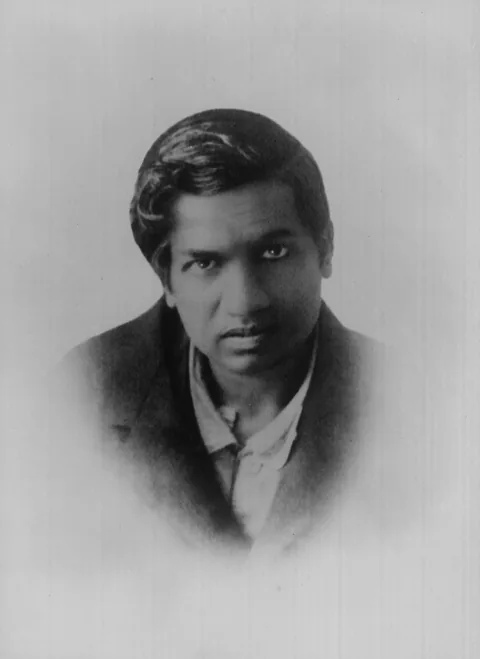

1. Work before international recognition
Srinivasa Ramanujan was born in Erode in 1887. He developed much of his mathematical knowledge through independent study and recorded results in notebooks. His route through formal education was uneven, and he later worked as a clerk at the Madras Port Trust. These circumstances should not become a message that education is unnecessary: access to books, time, income and people who could discuss his results all mattered.
He published mathematical work in India before moving to Cambridge. His 1911 paper on Bernoulli numbers is part of that record. In 1913 he wrote to G. H. Hardy, beginning a connection that led to collaboration. His mathematical life did not start when a British institution recognised him; that recognition changed the opportunities available to work he had already begun.
Sources: University of St Andrews, MacTutor: Srinivasa Ramanujan ↗ · Royal Society: Revisiting Ramanujan and archival records ↗
2. Ideas become shared mathematics
Ramanujan arrived in Cambridge in 1914 and worked with Hardy on important problems. They brought different experience and methods to their collaboration. A formula may be discovered through numerical exploration or a sudden insight, but publication must communicate what the symbols mean, where the claim applies and why it should be accepted. Intuition can suggest a route; reasoning makes the route available to others.
His surviving papers include work on partitions, continued fractions and infinite series. An infinite series involves adding terms according to an unending rule; understanding it requires studying how finite partial sums behave. It is not permission to manipulate infinity like an ordinary last number. This lesson focuses on partitions, where the starting question is accessible even though the deeper results require advanced mathematics.
Sources: Trinity College Library: Remembering Ramanujan ↗ · Trinity College: inventory of Ramanujan’s papers ↗ · University of St Andrews, MacTutor: Srinivasa Ramanujan ↗
3. What is an integer partition?
A partition of a positive integer is a way to write it as a sum of positive integers, ignoring order. The notation p(n) means the number of partitions of n; p is the function’s name, not a multiplication sign. For 4, the possibilities are 4; 3 + 1; 2 + 2; 2 + 1 + 1; and 1 + 1 + 1 + 1. Therefore p(4) = 5.
The expressions 3 + 1 and 1 + 3 represent the same partition. Writing each sum from largest part to smallest prevents this duplicate counting. As n grows, listing every partition becomes difficult. Hardy and Ramanujan developed an asymptotic formula for partition numbers: a formula describing their behaviour for large n. Ramanujan also found striking exact divisibility relationships. These are different kinds of result, one about large-number behaviour and the other about exact remainders.
Sources: ICTP: Freeman Dyson, Playing with Numbers, in One Hundred Reasons to Be a Scientist ↗ · University of St Andrews, MacTutor: Srinivasa Ramanujan ↗
4. A general pattern with a precise condition
One of Ramanujan’s results says that p(5k + 4) is divisible by 5 whenever k is a nonnegative integer: 0, 1, 2 and so on. The inputs begin 4, 9 and 14. Their partition numbers are 5, 30 and 135, all multiples of 5. The condition concerns the number being partitioned; the conclusion concerns how many partitions it has. Mixing up these two numbers changes the statement.
Checking those examples helps you understand the theorem but does not prove it for every permitted k. A proof must cover the whole stated class. We are explaining the statement, not pretending to reproduce its advanced proof. This distinction lets beginners appreciate a substantial achievement without replacing mathematics with a claim that a pattern merely looks convincing.
Sources: ICTP: Freeman Dyson, Playing with Numbers, in One Hundred Reasons to Be a Scientist ↗
5. Recognition and the continuing record
The main sequence is 1887, birth; 1911, the Bernoulli-number paper; 1913, correspondence with Hardy; 1914, arrival at Cambridge; 1918, election to the Royal Society and a fellowship at Trinity College; 1919, return to India; 1920, death. He was thirty-two when he died, but his notebooks continued to generate research questions long afterwards.
An archive preserves the record; later mathematicians check, prove and develop statements within it. This continuing labour does not diminish the originality of the earlier work. It shows how mathematics becomes a shared body of knowledge whose claims remain open to examination.
A life in milestones
- 1887Birth
- 1911Bernoulli-number paper
- 1913Correspondence with Hardy
- 1914Cambridge arrival
- 1918Royal Society and Trinity fellowships
- 1919Return to India
- 1920Death
Sources: Royal Society: Revisiting Ramanujan and archival records ↗ · Trinity College Library: Remembering Ramanujan ↗ · Trinity College: inventory of Ramanujan’s papers ↗
6. Worked learning case: list without duplicates
Find p(5). Group the partitions by their largest part: 5; 4 + 1; 3 + 2; 3 + 1 + 1; 2 + 2 + 1; 2 + 1 + 1 + 1; and 1 + 1 + 1 + 1 + 1. There are seven, so p(5) = 7. Check that each sum is 5 and that no sum is merely a rearrangement of another.
To check completeness, ask what the largest part can be: 5, 4, 3, 2 or 1. For each choice, the remaining parts must not exceed it. This supplies an organising argument rather than relying on memory. The calculation is a teaching example; it is not a new result attributed to Ramanujan.
Sources: ICTP: Freeman Dyson, Playing with Numbers, in One Hundred Reasons to Be a Scientist ↗
7. Worked learning case: testing is not proof
A learner notices p(2) = 2, p(3) = 3, p(4) = 5, p(5) = 7 and p(6) = 11, and conjectures that partition numbers from p(2) onward are always prime. A prime has exactly two positive divisors. But p(7) = 15, and 15 = 3 × 5. One counterexample disproves the universal claim, however attractive the earlier pattern was.
For comparison, the claim that n(n + 1) is even for every positive integer n has a short proof. Consecutive integers contain one even number, so their product is even. This original learning comparison shows what examples alone lack: a reason covering every allowed case. Mathematical creativity and rigorous checking support each other.
Sources: University of St Andrews, MacTutor: Srinivasa Ramanujan ↗ · ICTP: Freeman Dyson, Playing with Numbers, in One Hundred Reasons to Be a Scientist ↗
PUT IT INTO PRACTICE
Apply the lesson and check your reasoning
- List the partitions of 6 in descending order within each sum. Organise them by largest part.
- Count the list and explain how the grouping prevents duplicate or missing cases.
- For k = 0, 1, 2, calculate 5k + 4 and check divisibility using the partition numbers supplied in section 4.
- Check: p(6) = 11; the inputs are 4, 9, 14 and the quotients after dividing their partition numbers by 5 are 1, 6, 27. Explain why these checks illustrate the theorem but do not prove its general case.
Check your understanding
Why does order not count in a partition?
That is part of the definition. Counting ordered sums answers a different mathematical question.
Does p(5) mean five multiplied by p?
No. It names the number of partitions of 5, which is 7. Parentheses indicate the input to the function.
What does one counterexample establish?
It disproves a claim asserted for every allowed case. It need not explain all other cases.
Why was collaboration important?
It connected ideas with discussion, methods, publication and support. Ramanujan’s earlier independent work and later collaboration both matter.
Can examples replace a general proof?
Finite checks can reveal errors or suggest a theorem, but an unrestricted claim needs reasoning that covers its entire domain.