
The core idea
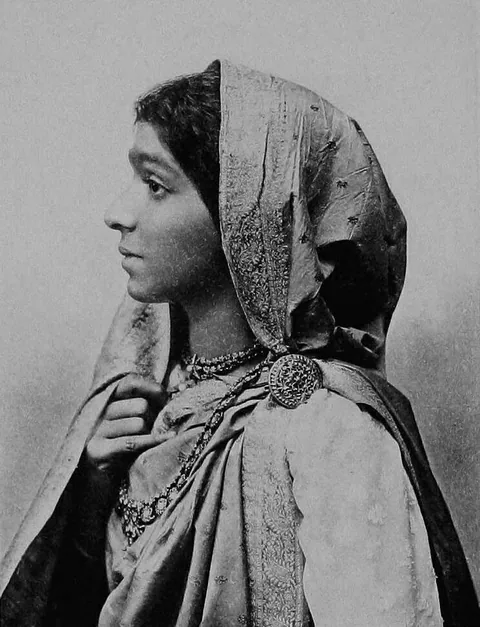
Naidu contributed English poetry rooted in Indian scenes and voices, participated in the independence movement, led the Congress session in 1925 and served as a provincial governor after independence.

1. Languages, opportunity and colonial India
Sarojini Naidu was born in Hyderabad in 1879 and died in 1949. Her life crossed the transition from colonial rule to independent India. She received educational opportunities in India and England, and wrote poetry in English while drawing on Indian settings. Access to education helped her reach influential audiences; many contemporary women faced much stronger barriers to such access.
English was a language of colonial power but could also be used to address that power and reach readers beyond one region. A writer’s choice of language does not tell us everything about political loyalty or cultural identity. We must examine what she wrote, whom she addressed and how her work circulated.
Sources: Maharashtra State Marathi Encyclopaedia: Sarojini Naidu ↗ · University of Hyderabad: Sarojini Naidu and Indian Womanhood ↗
2. How a poem builds a voice
Naidu’s collections include The Golden Threshold (1905), The Bird of Time (1912) and The Broken Wing (1917). A collection is a deliberately arranged group of works, not necessarily a diary of the poet’s own experiences. Speakers may be imagined workers, travellers or lovers. The author creates their words, but the speaker and author should not automatically be treated as the same person.
Rhythm gives language a pattern of movement; repetition makes an idea return; imagery connects words to sensory or imaginative experience. These devices do more than decorate an account. They influence pace, emphasis and the relationship between speaker and listener. To explain a poem, show what a device accomplishes in that particular passage. Simply listing “rhyme, imagery, repetition” leaves the explanation unfinished.
Sources: IGNOU: Sarojini Naidu’s poetry and publication history ↗ · University of Hyderabad: Sarojini Naidu and Indian Womanhood ↗
3. Public speech and collective action
Naidu became an important speaker and organiser in the independence movement. She presided over the Indian National Congress session at Kanpur in 1925 and took part in the Civil Disobedience Movement in 1930. The Dharasana salt protest included volunteers under her leadership. These were organised challenges to colonial authority, involving many leaders and participants.
Why did salt become politically significant? It was an everyday necessity, so restrictions and taxation connected the question of government power with ordinary life. Nonviolent resistance required discipline, coordination and an understandable public purpose. Describing an orator as effective is only a beginning: a historian also asks about organisations, audiences, repression and the work that continued after a speech ended.
Sources: Victoria Memorial Hall: Sarojini Naidu collection record ↗ · Kerala SCERT: Struggle and Freedom, Salt Satyagraha ↗
4. Representation and its limits
Naidu argued for women’s participation in public life and for cooperation across religious communities. Her prominence challenged the idea that politics belonged only to men. Yet the presence of one influential woman cannot demonstrate that all women possessed equal resources or decision-making power. Representation matters, and wider conditions still need examination.
In 1947 she was appointed governor of the United Provinces, the province later named Uttar Pradesh. This was a different role from presiding over a political organisation. Reading a biography carefully means identifying the institution and responsibility attached to each title. Admiration becomes more informative when we explain the work instead of collecting honorifics.
Sources: Maharashtra State Marathi Encyclopaedia: Sarojini Naidu ↗ · Victoria Memorial Hall: Sarojini Naidu collection record ↗ · University of Hyderabad: Sarojini Naidu and Indian Womanhood ↗ · Government of Uttar Pradesh: history of the provincial name ↗
5. Reading two careers together
Use this sequence: 1879, birth in Hyderabad; 1905, The Golden Threshold; 1912, The Bird of Time; 1917, The Broken Wing; 1925, Congress presidency at Kanpur; 1930, civil disobedience and salt protest; 1947, governorship; 1949, death. Label publications, movement events and official appointments separately so that the dates describe different kinds of activity.
The twenty years between the first listed collection and the Congress presidency do not measure a simple switch from poetry to politics. Lives can contain overlapping commitments. A timeline helps you ask when an activity became visible, but letters, poems, speeches and organisational records are needed to understand its changing significance.
A life in milestones
- 1879Birth
- 1905The Golden Threshold
- 1912The Bird of Time
- 1917The Broken Wing
- 1925Congress presidency
- 1930Civil disobedience and salt protest
- 1947Governorship
- 1949Death
Sources: IGNOU: Sarojini Naidu’s poetry and publication history ↗ · Maharashtra State Marathi Encyclopaedia: Sarojini Naidu ↗ · Victoria Memorial Hall: Sarojini Naidu collection record ↗
6. Worked learning case: a collective speaker
In Coromandel Fishers, a speaker calls fellow fishers towards their work and presents the sea through family relationships. The repeated invitations and shared identity create a sense of collective movement. Suppose a learner says, “This proves that fishing was always comfortable and safe.” The conclusion does not follow. A poem can express attachment, confidence or longing while leaving material dangers outside its focus.
A stronger answer explains that the family imagery makes the natural world feel close to the speaking community. This is interpretation grounded in the poem, not a survey of workers. To investigate historical working conditions, consult records about boats, weather, income and labour alongside the literary text.
Sources: Sarojini Naidu: The Golden Threshold, original poems ↗
7. Worked learning case: improve a public argument
Consider an invented youth-library speech: “Our library welcomes everyone, so access must already be equal.” The first part states an intention; the conclusion requires evidence. A better argument asks whether opening times, language choices and physical access actually allow different learners to participate. It can then propose a change and a way to check the result. This is a contemporary exercise, not a speech attributed to Naidu.
The worked improvement joins a shared value, a verifiable question and a practical proposal. Emotional force can help an audience care, but it cannot substitute for evidence. Learning about Naidu’s public communication should strengthen our ability to listen critically as well as to speak clearly.
Sources: Victoria Memorial Hall: Sarojini Naidu collection record ↗ · University of Hyderabad: Sarojini Naidu and Indian Womanhood ↗
PUT IT INTO PRACTICE
Apply the lesson and check your reasoning
- Place three publications and two public roles on a timeline. Identify which entries are books and which are appointments or organisational roles.
- Explain how one image in Coromandel Fishers shapes the relationship between people and the sea.
- Write an original three-sentence proposal for a youth club: shared purpose, evidence needed and a possible action.
- Check that your literary claim concerns the poem, your factual claim can be investigated and your proposal is labelled as your own, not a historical quotation.
Check your understanding
Is a poem’s speaker always the poet?
No. A poet can create a voice or community perspective. Interpret the chosen voice without treating it as autobiography.
What makes repetition meaningful?
It can coordinate rhythm, emphasise a request or build shared identity. Its effect depends on the passage.
Why distinguish Congress president from governor?
The titles belong to different institutions and responsibilities. Naming the institution prevents misleading comparisons.
Does a prominent woman prove universal equality?
No. Her achievement can challenge exclusion while inequalities remain for others. Both facts deserve attention.
Can persuasive language replace evidence?
It can attract attention and express a value, but factual conclusions still need support that listeners can examine.