
The core idea
Kalam was an aerospace engineer, programme leader and India’s eleventh president. His contribution is best understood through teams, testing and public purpose. The 1979 and 1980 SLV-3 flights provide a concrete way to learn why ambitious engineering requires evidence, revision and cooperation.
From a requirement to a better design
- DefineHold a small load across a fixed gap.
- TestKeep span, paper and test load the same.
- Change one featureTry a folded section instead of a flat strip.
- Compare and explainRecord the result, including a failure.
From Rameswaram to engineering leadership
Avul Pakir Jainulabdeen Abdul Kalam was born on 15 October 1931 in Rameswaram, Tamil Nadu. He studied aeronautical engineering at the Madras Institute of Technology. His official profile describes work at ISRO and DRDO and a later emphasis on education and national development. A life in engineering involves institutions, colleagues and successive assignments; it is more informative to trace those connections than to present an achievement as the work of one isolated genius.
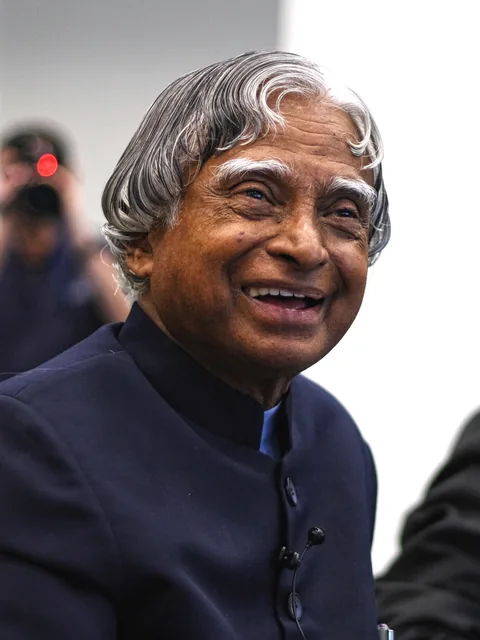

SLV-3: compare the result, not just the ambition
Kalam was project director of SLV-3. ISRO records the first experimental flight in August 1979 as only partially successful; on 18 July 1980 the vehicle placed Rohini RS-1 in orbit. The programme illustrates the difference between having a design, testing it and demonstrating the intended result. An honest account retains the earlier outcome because it helps explain the engineering process. Removing failures from a biography makes success less understandable rather than more impressive.
Sources: ISRO: Satellite Launch Vehicle ↗ · President of India: A. P. J. Abdul Kalam profile ↗
Why reaching high is not the same as reaching orbit
A thrown ball rises and falls. A satellite also falls under gravity, but sufficient sideways speed allows it to keep falling around Earth instead of immediately meeting the surface. A launch vehicle must therefore supply an appropriate trajectory and velocity, not merely altitude. This explanation is simplified: real launches must also manage changing mass, air resistance, staging and guidance. The educational lesson is that success should be defined by the full requirement, not by the most visible part of the demonstration.
Sources: NASA: What is an orbit? ↗
Defence, the presidency and public purpose
Kalam’s official career includes missile-development leadership and service as president from 2002 to 2007. Admirers connect his work with technological self-reliance and his engagement with students. A thoughtful assessment can also ask how a country weighs defence capability, public cost and civilian needs. Those questions do not erase technical work; they place it in public life. National pride becomes more useful when it encourages understanding of how a capability was built and what responsibilities accompany it.
Worked example: improve a paper bridge
Make a small paper bridge between two books and test it with a few identical light objects. Record the span, paper and fold before adding weight. If it sags, change only one feature, such as the fold, and repeat with the same span. You are not recreating rocket engineering; you are practising a transferable habit: a clear requirement, a controlled change and a recorded result. Do not hide an unsuccessful trial. It can show which idea to abandon or improve.
Turn inspiration into a record of work
A useful response to an inspiring scientist is to keep a notebook of questions, trials and revisions. Write what you expected before seeing the result. Credit the person who helped, including someone who pointed out an error. Choose a project small enough to finish and explain. This produces evidence of learning, not just a collection of slogans. When sharing a quotation attributed to Kalam, check a dated speech or publication; the attractiveness of a sentence does not establish its author.
PUT IT INTO PRACTICE
Work through an example
- Build and document the small bridge using only light test objects.
- Change one feature and compare the outcomes fairly.
- Explain both a failed trial and a successful change in three sentences.
Check your understanding
When did SLV-3 place RS-1 in orbit?
18 July 1980.
Why does altitude alone not establish orbit?
The appropriate sideways velocity and trajectory are also needed.
Why retain an unsuccessful trial?
It is evidence that helps compare designs and explain improvement.
How should a popular quotation be checked?
Look for a traceable speech, book or other original record.