
The core idea
Aryabhata’s Aryabhatiya belongs to the mathematical-astronomical tradition of early India. Its methods connect calculation with problems of time and the sky. Studying an actual method honours that achievement more precisely than claiming that every modern discovery was already present in antiquity.
What does an approximation let us calculate?
| Quantity | Calculation |
|---|---|
| Diameter | 10 units |
| Approximate π | 3.1416 |
| Circumference | 3.1416 × 10 = 31.416 units |
| If π is rounded to 3.14 | 31.4 units |
| Difference in these answers | 0.016 units |
A life known especially through work
Aryabhata is associated with the Aryabhatiya, conventionally dated to 499 CE. Our knowledge of such early scholars is often much fuller about surviving mathematical work than about everyday personal life. A careful biography can say this plainly while still teaching substantial ideas. The Indian National Science Academy lists editions and studies of the text, and modern researchers continue to examine its methods. There is no need to invent childhood anecdotes to make the work worth reading.

Sources: Indian National Science Academy: history of science publications ↗ · Singh and Kumar (2023): Aryabhata’s trigonometric table ↗
What does a sine table accomplish?
A sine table relates an angle to a geometric length or ratio. Before electronic calculators, a table allowed repeated calculations without starting geometry afresh each time. In modern notation, on a unit circle the sine of an angle is the vertical coordinate of the corresponding point. Historical Indian tables used their own scale and terminology. Translating into modern notation is helpful for learning, provided we do not pretend that the historical author wrote in the symbols we use today.
Sources: Singh and Kumar (2023): Aryabhata’s trigonometric table ↗
Why differences help construct a table
Instead of listing only values, a calculator can work with the differences between neighbouring values. If the first value is known and the next difference is known, addition gives the next value. Repeating that operation produces a table. Singh and Kumar’s 2023 mathematical exposition studies Aryabhata’s sine-table construction through geometric reasoning and difference relations. This is a specific, inspectable achievement. It invites us to understand the argument rather than merely repeat that ancient mathematics was advanced.
Sources: Singh and Kumar (2023): Aryabhata’s trigonometric table ↗
Worked example: a remainder problem
Find a positive whole number x for which 7x leaves remainder 1 when divided by 5. Write 7x = 5y + 1. Trying x = 1, 2, 3 gives 7, 14, 21; the third value is 5 × 4 + 1, so x = 3 and y = 4 work. Also x = 3 + 5k gives further solutions for whole-number k. This small example introduces the kind of integer problem connected with the kuttaka tradition; it is not a complete derivation of Aryabhata’s general algorithm.
Specific credit is stronger than a universal claim
“This text contains a method for a defined mathematical problem” is a claim we can examine. “It contains all modern science” is so broad that it conceals the real work. Astronomy, religious calendars and Sanskrit scholarship interacted historically, but this does not make every religious interpretation a scientific finding. Respectful study names the author, text, problem and method. It also recognises later commentators and other traditions that developed mathematics through exchange and disagreement.
An ancient name in modern space history
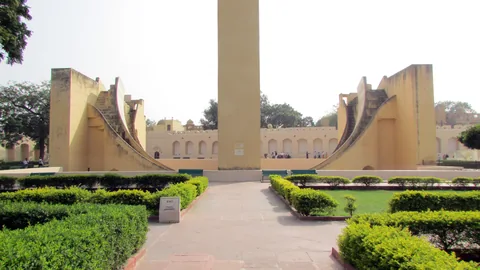
India’s first satellite was named Aryabhata. ISRO records that it was designed and built in India and launched by a Soviet rocket on 19 April 1975. That naming connects modern scientific work with an older intellectual inheritance; it does not mean the ancient scholar built a satellite. The instrument pictured in this lesson is a much later Jaipur observatory instrument, included to illustrate measurement of the sky. Its caption matters: it is not a portrait or an instrument personally used by Aryabhata.
PUT IT INTO PRACTICE
Work through an example
- Check x = 3 and x = 8 in the equation 7x = 5y + 1.
- Find the corresponding y values and explain why adding 5 to x preserves the remainder.
- Write one precise historical claim and the source that supports it.
Check your understanding
For x = 8, what is y?
7 × 8 = 56 = 5 × 11 + 1, so y = 11.
What does a sine table connect?
Angles and corresponding geometric lengths or ratios.
Was the Jaipur instrument used by Aryabhata?
No. It belongs to a much later observatory tradition.
When was the satellite Aryabhata launched?
19 April 1975.