
The core idea
Nehru’s legacy includes democratic institution-building, public investment and an independent foreign-policy ambition. It also includes contested economic priorities and the serious failure exposed by the 1962 war. A useful assessment can recognise achievements and shortcomings together, and ask what evidence would change a judgment.
| Question | A case for a public project | A question it must answer |
|---|---|---|
| Capability | Training can build skills over decades. | What skills were gained, and by whom? |
| Access | Public funding may widen opportunity. | Which groups still could not attend? |
| Cost | Shared infrastructure may lower barriers. | What alternative use of the money was available? |
From education to the independence movement
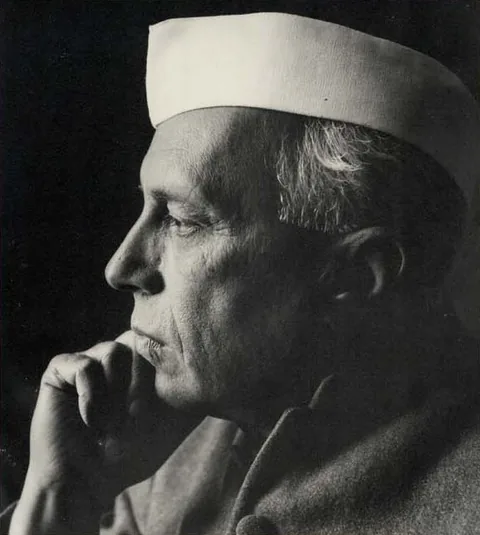
Born in Allahabad on 14 November 1889, Nehru studied in England, including natural sciences at Cambridge and law at the Inner Temple. He returned to India in 1912 and became deeply involved in the independence movement. These facts explain one part of his formation: an internationally educated Indian confronting colonial rule. They do not by themselves prove that every later decision was enlightened or alien to India. A biography needs the decisions and their context, not conclusions drawn from where someone studied.

Sources: Prime Minister of India: Jawaharlal Nehru biography ↗
1947–1964: governing while building institutions
Nehru served as prime minister from independence until his death in 1964. The early republic had to make democratic government work while responding to Partition, poverty and competing visions of nationhood. Institution-building means more than a leader’s speeches: it includes procedures that allow disagreement, succession and scrutiny. When evaluating this period, ask what institutions made participation possible and where power remained concentrated. Neither the difficulty of the starting point nor admiration for democracy removes the need to examine particular decisions.
Sources: Prime Minister of India: Jawaharlal Nehru biography ↗
Planning: what supporters and critics value
India adopted a mixed economy with a large public role; the Second Five Year Plan emphasised heavy industry. A left-leaning defence stresses infrastructure, redistribution and the limits of private capital in a poor country. A market-oriented criticism asks whether controls weakened competition and whether capital could have been used better. A further criticism, also possible from the left, asks whether rural livelihoods and basic services received enough attention. These are distinct arguments: “left” and “right” do not each have only one position.
Non-alignment and the shock of 1962
Non-alignment sought freedom to judge international issues without automatic attachment to a Cold War bloc. Its strongest defence is strategic autonomy; an important criticism asks whether diplomatic hopes were matched by security preparedness. The 1962 war with China was a major setback and brought severe criticism of Nehru’s leadership. Recognising that failure does not settle every question about non-alignment, just as valuing autonomy does not answer questions about the border and defence. Separate a general principle from how it was implemented.
Sources: NCERT: India’s External Relations ↗
Worked example: judge a public project fairly
Imagine evaluating a publicly financed engineering institute. A supporter points to graduates and research; a critic asks about cost and who gains admission. Both questions can be legitimate. Compare the institute with a realistic alternative use of the same resources, over the same period. Record who benefits directly, what wider benefits might occur and what evidence is missing. This exercise avoids the mistake of treating a visible building as sufficient proof of success or treating public ownership as sufficient proof of failure.
Write a conclusion that could be revised
A balanced conclusion is not half praise and half blame by arithmetic. It states a criterion, weighs evidence and shows limits. You might value democratic continuity while disagreeing with a particular economic restriction. Someone else may assign greater weight to rapid industrial capacity. Compare those criteria openly. Avoid attributing a modern party’s whole platform to a twentieth-century figure. Historical understanding improves when a reader can explain an argument they reject accurately before offering reasons against it.
PUT IT INTO PRACTICE
Work through an example
- Choose planning or non-alignment and define the outcome you will assess.
- Write the strongest supporting argument and the strongest criticism.
- List evidence needed and one finding that would change your conclusion.
Check your understanding
Was non-alignment simply refusing to have a foreign policy?
No. It sought independent judgment rather than automatic bloc alignment.
Can the left criticise a public-investment strategy?
Yes, for example by questioning distribution or neglected rural needs.
What was the major security setback discussed here?
The 1962 war with China.
Does balance mean equal praise and criticism?
No. The weight should follow evidence and clearly stated criteria.