
The core idea
Raman and collaborators established a change in the frequency of a small part of light scattered by matter. The Raman effect provides information about molecular energy changes.
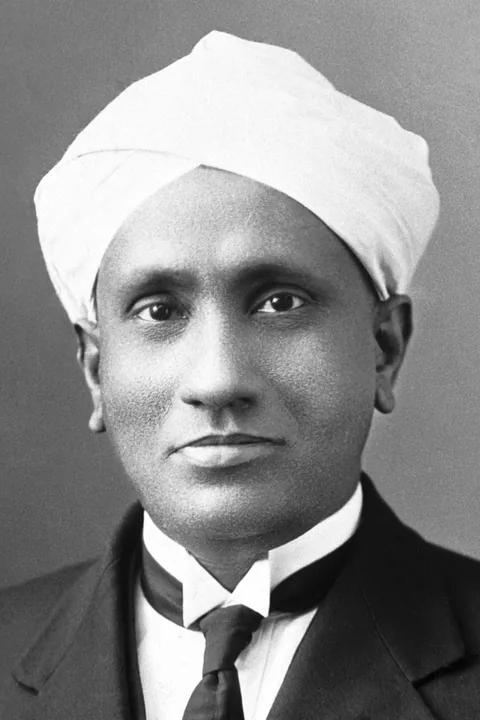


1. Building a research career
Chandrasekhara Venkata Raman was born in Tiruchirappalli in 1888. After studying in Madras, he joined the Indian Finance Department in 1907 while continuing experimental work at the Indian Association for the Cultivation of Science in Calcutta. He accepted a physics professorship at Calcutta University in 1917. These details show that his research developed through study, access to a laboratory and sustained work.
His interests included sound as well as light. Asking how a musical instrument vibrates and asking how light interacts with matter both require connecting an observable pattern with a physical explanation. Curiosity starts the process, but careful records and measurements make a claim useful to other scientists.
2. A small signal and a difficult question
When light enters a material, some can be redirected: this is scattering. Raman’s group investigated whether all scattered light retained the same frequency as the incoming light. Their work culminated in the discovery associated with 28 February 1928. His account names collaborators including K. S. Krishnan and discusses earlier observations by K. R. Ramanathan and S. Venkateswaran. Discovery was a developing investigation, not a single unexplained flash of inspiration.
A faint extra signal could have come from contamination or another optical process. The investigators had to compare explanations and improve observations. A useful result therefore includes both what was seen and why competing explanations were judged inadequate. The original experiments belong to specialist laboratory history; this lesson uses paper reasoning, not instructions to reproduce their apparatus.
Sources: C. V. Raman: A new radiation, 1928, Indian Academy archive ↗ · Nobel Prize: C. V. Raman, biographical account ↗
3. Following the energy
Think of light exchanging energy in packets called photons. Photon energy increases with frequency. In ordinary elastic scattering, the photon’s energy and frequency are unchanged, even though its direction may change. In Raman scattering, a molecule and the light exchange energy, so the scattered photon has a different frequency. The total energy of the combined system is still conserved.
If the molecule gains energy, the photon leaves with less energy and a lower frequency. If a suitably excited molecule gives energy to the photon, the outgoing frequency is higher. Molecular vibrations and rotations have characteristic energy changes, so measuring the shifts can reveal information about molecular structure. This is different from simply observing that a material looks red or blue in daylight.
Sources: Nobel Prize: physics discoveries and molecular energy shifts ↗
4. From discovery to a method
A spectrum separates a light signal by frequency or wavelength. Raman spectroscopy examines the shifted components and their pattern. Comparing that pattern with suitable reference measurements helps researchers investigate a substance. A pattern is informative because different molecular arrangements interact with light differently; it is not a photograph showing each molecule directly.
The method requires interpretation. Background signals, mixed materials and measurement uncertainty can complicate a comparison. Recognition of Raman’s achievement should include this discipline of checking. He later worked at the Indian Institute of Science and founded the Raman Research Institute in 1948, supporting continued basic research. Instruments, trained people and institutions allow questions to outlive the person who first makes them famous.
Sources: IISc: A Century of Quantum Mechanics ↗ · C. V. Raman: A new radiation, 1928, Indian Academy archive ↗ · Raman Research Institute: institutional history ↗
5. An evidence-based timeline
Arrange these milestones: 1888, birth; 1907, Finance Department employment alongside research; 1917, the Calcutta professorship; 1928, the scattering discovery; 1930, the Nobel Prize in Physics; 1933, work at the Indian Institute of Science; 1948, the Raman Research Institute; 1970, death. The two-year gap between discovery and prize separates the scientific result from later recognition.
An award tells us that an achievement was recognised; the research publication tells us what claim was made and what supported it. Read both kinds of record. Neither a prize nor a famous name removes the need for other scientists to examine an explanation.
A life in milestones
- 1888Birth
- 1907Finance work alongside research
- 1917Calcutta professorship
- 1928Raman effect
- 1930Nobel Prize in Physics
- 1933Indian Institute of Science
- 1948Raman Research Institute
- 1970Death
Sources: Nobel Prize: C. V. Raman, biographical account ↗ · Raman Research Institute: institutional history ↗
6. Worked learning case: account for a shift
Use a hypothetical paper model with energy measured in arbitrary units, not actual experimental values. An incoming photon has 10 units and leaves with 9 units. The molecule must gain 1 unit: 10 = 9 + 1. Because the outgoing photon has less energy, it has a lower frequency. Energy has been transferred, not destroyed.
Now let an excited molecule lose 1 unit to an incoming 10-unit photon. The outgoing photon has 11 units and a higher frequency: 10 + 1 = 11. The molecule must initially have the appropriate energy available. These two accounts help prevent the mistaken idea that every scattered photon necessarily loses energy.
Sources: Nobel Prize: physics discoveries and molecular energy shifts ↗
7. Worked learning case: test an identification
Imagine a simplified reference card with peaks at positions A and C. A hypothetical unknown also shows A and C, plus B. A learner concludes that the unknown must be exactly the reference substance. The matching peaks support a possible connection, but the extra peak needs explanation: a mixture, background or another material could be involved.
A stronger plan compares a background record, repeats the measurement and examines more of the pattern under comparable conditions. The worked conclusion is “consistent with part of the reference pattern; identification remains incomplete.” This is more scientifically useful than a confident label that ignores contradictory evidence. It reflects the broader investigative habit illustrated by Raman’s work.
Sources: IISc: A Century of Quantum Mechanics ↗ · C. V. Raman: A new radiation, 1928, Indian Academy archive ↗
PUT IT INTO PRACTICE
Apply the lesson and check your reasoning
- Draw an incoming photon, a molecule and an outgoing photon. Label the diagram as a hypothetical energy model.
- Give the incoming photon 12 arbitrary units and let the molecule gain 2 units. Calculate the outgoing energy and predict the frequency change.
- Add a second case in which the molecule loses 2 units to the same incoming photon, and explain what must be true initially.
- Check: 10 units and lower frequency in the first case; 14 units and higher frequency in the second. The molecule needs an appropriate excited state in the second case. Both accounts conserve total energy.
Check your understanding
Does scattering always change frequency?
No. Elastic scattering changes direction without changing photon energy; Raman scattering involves an energy exchange and a frequency shift.
Why mention Krishnan and other investigators?
The research record documents their contributions. Naming collaborators explains how the investigation developed.
Where does a photon’s lost energy go?
In the simplified Raman account, the molecule gains it. The combined system conserves energy.
Why are matching peaks not always enough?
A partial match may occur in mixtures or with interfering signals. Additional evidence can distinguish alternatives.
What does the Nobel Prize establish?
It records recognition of the achievement. The scientific explanation still rests on evidence and testable reasoning.