
The core idea
Photosynthesis uses light energy to build organic molecules from carbon dioxide and water. Xylem carries water and dissolved minerals, while phloem distributes sugars from sources to places that use or store them.

1. A growing plant needs both matter and energy
Plant growth requires atoms for new molecules and energy for building and maintaining them. Sunlight supplies energy, but it is not a material ingredient with carbon atoms. Much of the carbon in a plant’s organic material comes from carbon dioxide in the air. Roots supply water and mineral nutrients such as nitrogen-containing ions, which are needed for making proteins and other compounds. Soil is therefore important without being the main source of the carbon in a tree’s wood. Calling fertiliser “plant food” can confuse these roles: mineral nutrients support growth, while photosynthesis makes energy-rich organic substances using carbon obtained largely from the air.
Sources: NCERT: Life Processes ↗ · NIOS: Life Processes I ↗
2. Light drives a sequence of reactions
Chlorophyll pigments in chloroplasts absorb light. In connected reactions, light energy helps split water and supports the formation of carbohydrates from carbon dioxide. The oxygen released in photosynthesis comes from water. A useful simplified net equation is 6CO₂ + 6H₂O → C₆H₁₂O₆ + 6O₂, with light and chlorophyll indicated as conditions. C, H and O mean carbon, hydrogen and oxygen; the numbers conserve atoms. The equation summarises many steps and uses glucose as a convenient carbohydrate product; it is not a claim that six water molecules instantly assemble one glucose molecule. Plants convert products into transport sugars, starch, cellulose and other materials.
Sources: NCERT: Life Processes ↗ · NIOS: Life Processes I ↗
3. Leaves balance gas access and water loss
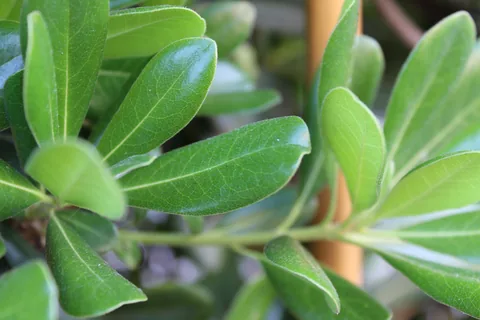
A broad leaf exposes a large area to light. Its internal air spaces connect photosynthetic cells with small pores called stomata. Carbon dioxide can diffuse inward when its concentration inside is lower, while oxygen and water vapour can move outward under appropriate gradients. Guard cells change the opening of each stoma. Open pores improve access to carbon dioxide but also provide a route for water loss, creating a trade-off. Closing stomata can conserve water while limiting photosynthesis. Stomatal behaviour varies among plants and conditions, so “every leaf pore is always open in daylight” is too simple. The leaf’s structure supports exchange while regulation adjusts it.
Sources: NCERT: Life Processes ↗ · NIOS: Life Processes I ↗
4. Water moves through a connected pathway
Root hairs increase contact with moist soil. Water crosses root tissues and enters xylem, whose conducting vessels and tracheids form pathways through roots, stems and leaves. Evaporation from leaf surfaces, called transpiration, creates tension in the water pathway. Cohesion between water molecules helps maintain a connected column that can be pulled upward; interaction with xylem walls also helps. Root pressure can contribute under some conditions but cannot alone explain water reaching the tops of tall trees. Dissolved mineral ions travel with the water. Water potential describes water’s tendency to move and depends on factors including pressure and dissolved solutes. Water moves from higher towards lower water potential along this connected route.
Sources: NCERT: Life Processes ↗ · NIOS: Life Processes I ↗ · OpenStax, Rice University: Transport of Water and Solutes in Plants ↗
5. Sugars travel from sources to sinks
A source supplies sugar to the transport system, such as a mature photosynthesising leaf. A sink uses or stores it, such as a growing root, fruit or seed. Phloem transports dissolved sugars through living sieve-tube systems with the help of companion cells. Loading sugar can draw water in by osmosis and build a pressure difference that helps drive flow towards sinks. Energy is required for important loading or unloading processes. Transport is not simply “food always goes downward”: a developing shoot above a source leaf can receive sugar too. Which organ acts as a source can change as stored material is mobilised during growth.
Follow materials through a plant
- Roots → leavesWater and minerals travel mainly through xylem.
- Air → leafCarbon dioxide enters through stomata.
- Light → chemical energyPhotosynthesis builds sugars from carbon dioxide and water.
- Source → sinkPhloem carries sugars to places using or storing them.
Sources: NCERT: Life Processes ↗ · NIOS: Life Processes I ↗ · OpenStax, Rice University: Transport of Water and Solutes in Plants ↗
6. Worked example: trace carbon rather than sunlight mass
Illustrative particle-accounting model: suppose the simplified photosynthesis equation runs twice. Twelve CO₂ molecules supply twelve carbon atoms, enough for two glucose molecules because each glucose contains six carbon atoms. The corresponding net equation uses twelve H₂O and produces twelve O₂. Check hydrogen: twelve waters contain twenty-four H atoms; two glucose molecules also contain twenty-four. Check oxygen: the inputs contain thirty-six O atoms, matched by twelve in glucose plus twenty-four in O₂. Light supplies energy without adding atoms to this ledger. Actual photosynthesis includes intermediate molecules and recycled water, so this balanced summary does not show the detailed route followed by every oxygen atom.
Sources: NCERT: Life Processes ↗ · NIOS: Life Processes I ↗
7. Worked example: net oxygen is not total production
Plants respire in light as well as darkness. Illustrative model data for one time interval: photosynthesis produces 18 arbitrary units of oxygen while respiration consumes 6 units. Net oxygen released is 18 − 6 = 12 units. In darkness, if photosynthesis stops and respiration still consumes 6 units over an equal interval, net exchange is an uptake of 6 units. “Arbitrary units” here are invented comparable quantities, not a measured plant rate. A gas-exchange reading combines both processes. Therefore a small net output could mean slow photosynthesis, considerable respiratory use, or both; additional evidence is needed to separate the explanations.
Sources: NCERT: Life Processes ↗ · NIOS: Life Processes I ↗
PUT IT INTO PRACTICE
Apply your understanding
- Draw separate arrows for light energy, carbon dioxide, water, minerals and sugar. Show which enter from outside and which are transported within the plant.
- In illustrative equal intervals, gross oxygen production is 4, 8 and 8 units as light increases, while respiratory use stays 2 units. Calculate the three net outputs.
- Check: 2, 6 and 6 units. Explain why the plateau suggests another limiting condition and does not prove that the plant stopped responding to its environment.
Check your understanding
Is sunlight a source of the carbon in glucose?
No. Carbon comes from carbon dioxide in this process. Light supplies energy for chemical changes, so matter sources and energy sources must be tracked separately.
Why can closing stomata reduce photosynthesis?
It reduces the route for carbon dioxide entry. Conserving water can therefore limit a reactant’s supply even when light remains available.
Why is xylem different from phloem?
Xylem mainly carries water and dissolved minerals, while phloem transports sugars between sources and sinks. Their conducting structures and driving mechanisms also differ.
Do plants stop respiration when photosynthesis begins?
No. Cells continue needing usable energy. In light both processes occur, so observed gas exchange is their combined net effect.
Why can more light fail to increase sugar production?
Another requirement, such as carbon dioxide, water or suitable temperature, may limit the process. Increasing one input cannot remove every other constraint.