
The core idea
The tricolour has three equal horizontal bands and a navy-blue Ashoka Chakra with 24 spokes. The State Emblem adapts Ashoka’s Sarnath Lion Capital. Constitutional values give national belonging practical meaning through justice, freedom, equality and fraternity.
1. The tricolour: a precise design
The Constituent Assembly adopted the present national flag on 22 July 1947. Its length-to-height ratio is 3:2. India saffron is above white, which is above India green; the three bands have equal height. The navy-blue Ashoka Chakra sits in the centre of the white band and has 24 equally spaced spokes. These details distinguish the national flag from a decorative arrangement of three colours. On a flag 90 centimetres long, the correct height is 60 centimetres and each horizontal band is 20 centimetres high.

Sources: Ministry of Home Affairs: Flag Code of India ↗ · National Portal of India: The Indian tricolour ↗
2. Colours connect identity to ideals
The National Portal’s explanation connects saffron with strength and courage, white with peace and truth, and green with the land’s fertility and growth. The wheel connects the design to the dharma chakra in India’s historical heritage. These explanations are useful because a symbol invites conduct as well as recognition. Courage can mean speaking honestly when a convenient falsehood would benefit us. Peace can mean resolving a disagreement without humiliation or violence. Care for the land can mean maintaining a public garden rather than merely using green in a poster.
3. The State Emblem and Satyameva Jayate
India’s State Emblem is adapted from the Lion Capital of Ashoka at Sarnath. The original capital has four lions facing outward; three are visible in the familiar two-dimensional representation. Beneath the representation appears “Satyameva Jayate” in Devanagari, meaning that truth alone triumphs. The emblem is a formal symbol of the state, not a general badge for any organisation that wishes to look official. Its legal use is regulated. A school can teach its history without suggesting that every school certificate has government approval.
Sources: Government presentation resources: State Emblem of India ↗ · Ministry of Home Affairs: National Flag, Emblem and Anthem ↗
4. Justice, liberty, equality and fraternity
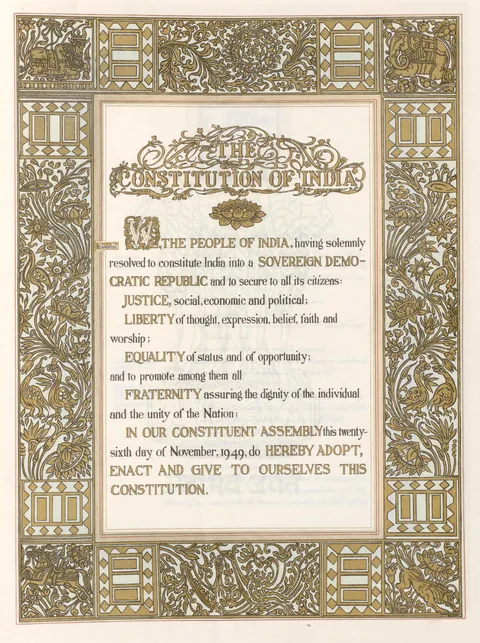
Justice concerns fair treatment and the correction of disadvantage. Liberty gives room for thought, expression, belief and conscience within the constitutional order. Equality rejects the idea that a person’s dignity depends on status or inherited privilege. Fraternity asks citizens to recognise one another as members of a shared political community. These values support each other. A meeting that lets only wealthy members speak may be formally open but unequal in practice. A fairer meeting makes information accessible, gives people a chance to participate and applies its rules consistently.
Sources: Legislative Department: Constitution of India, 2024 ↗
5. National pride has everyday responsibilities
Article 51A lists Fundamental Duties, including respect for the Constitution and national symbols, harmony across differences, preservation of cultural heritage, environmental protection, compassion for living creatures and scientific temper. These ideas connect directly to ordinary work. An animal-welfare volunteer practises compassion; a learner who checks an exaggerated claim practises inquiry; a person who keeps a public place usable protects shared resources. Pride becomes more durable when it produces reliable habits. It does not require insulting another language, religion or country to make our own contribution meaningful.
6. Work it out: an Independence Day event
A community plans a flag ceremony and learning session. A good plan uses the correct flag design, assigns responsible handling and follows current official instructions. It also provides seating for older participants, makes the message understandable to children and arranges waste collection afterwards. During discussion, a student questions a claim on a poster. Checking and correcting it demonstrates respect for truth; silencing the question would miss the lesson. The ceremony marks belonging, while accessibility, truthful information and shared work put that belonging into practice.
Sources: Ministry of Home Affairs: Flag Code of India ↗ · Ministry of Home Affairs: National Flag, Emblem and Anthem ↗ · Constitution of India: Fundamental Duties ↗
PUT IT INTO PRACTICE
Turn one value into an action
- Choose truth, equality, environmental care or compassion and describe it in your own words.
- Design a small activity where that value changes how decisions are made, not only what appears on a poster.
- State how you would know the activity helped: clearer information, wider participation or a maintained shared space.
Check your understanding
A flag is 150 cm long. What should its height be?
100 cm: multiplying the length by two-thirds preserves the 3:2 ratio. Each equal band would be about 33.3 cm high.
Where does the State Emblem’s lion design come from?
The Lion Capital of Ashoka at Sarnath. The emblem adapts a historical object into a formal symbol of the Republic.
Why does correcting a false patriotic claim serve national pride?
Truth and scientific temper are themselves part of public responsibility. Reliable knowledge strengthens trust more than an impressive but false story.
Is a welcoming slogan enough to make an event inclusive?
No. People also need practical access, understandable information and a fair chance to take part. Values must shape arrangements.