
The core idea
In Vaishnava traditions, Vishnu and his forms are central to divine protection and the restoration of dharma. An avatara is a divine descent, not simply an inspiring human role model. Reading Rama and Krishna carefully lets us study both sacred narratives and the responsibilities their teachings bring into focus.
Recognise Vishnu without reducing him to a symbol
Vishnu’s familiar four-armed form is associated with the conch, discus, mace and lotus. Sacred art gives the worshipper an identifiable form for devotion. The Bihar sculpture pictured here places Lakshmi and Sarasvati beside Vishnu and dates to approximately the later eleventh century. Its arrangement shows a particular regional artistic tradition; it does not mean that every Vaishnava shrine must have the same arrangement.
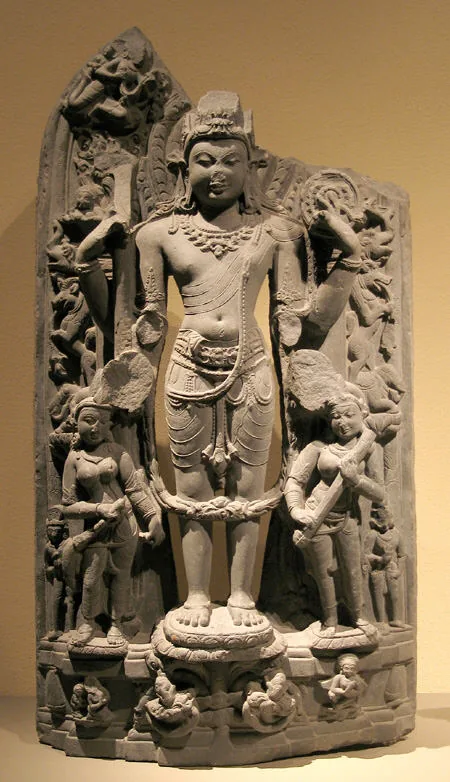
Sources: The Met: Vishnu with Lakshmi and Sarasvati ↗ · Vidya Dehejia, The Met: Hinduism and Hindu Art ↗
Avatara and restoring dharma
The Gita’s fourth chapter describes divine manifestation in relation to the decline of dharma and the protection of the good. Dharma here cannot be reduced to personal preference: it concerns the order and obligations that sustain life. An avatara is understood religiously as divine participation in the world. Rama and Krishna are approached in different devotional and philosophical traditions, so learning an account includes asking which text and community gives it that form.
Rama and the difficulty of responsibility
The Ramayana gives responsibility a human setting: family loyalties, promises, rule and exile. A useful first question is what a character believes they owe to others. A second is who bears the consequences. Keeping both questions in view prevents “duty” from becoming a word used to end discussion. The epic’s place as sacred history in Hindu tradition is central to its reception. Studying a particular episode carefully gives more insight than treating every decision as an easy slogan.
Krishna: action and devotion belong together
Gita 2.47 directs attention to action without possessiveness over results and also rejects attachment to inaction. In 9.26, the simple offering of a leaf, flower, fruit or water is connected with devotion. Together these passages allow a beginner to see why spiritual life need not be separated from ordinary work. An offering is not a purchase of guaranteed success. Its significance lies in the relationship and intention with which it is made.
Sources: IIT Kanpur Gita Supersite: Gita 2.47 ↗ · IIT Kanpur Gita Supersite: Gita 9.26 ↗
Worked example: a promise and limited time
A student has promised to help at a neighbourhood class but has an examination the next morning. One response is to disappear; another is to attend unprepared and resentfully. A better inquiry asks what was promised, who depends on it and what honest alternatives exist. The student could inform the organiser early, prepare material and arrange a replacement. This is our everyday application of responsibility, not an assertion that an epic supplies a ready-made answer to every timetable problem.
Choose a route into further study
If narrative draws you in, continue with the Ramayana and Mahabharata lessons. If a short passage helps, start with the shloka reader and then its linked full lesson. If worship is your interest, begin with an understood offering or a prayer already meaningful in your family. These routes can complement one another. Learning slowly enough to explain a passage in your own words is more useful than collecting a large number of quotations whose context you cannot recall.
PUT IT INTO PRACTICE
Work through an example
- Describe the attributes you can actually see in the sculpture.
- Explain how an offering differs from buying an outcome.
- Resolve the examination example with a clear promise, early communication and a practical alternative.
Check your understanding
What is an avatara?
A divine descent or manifestation within religious tradition.
Does nonattachment mean inaction?
No. Gita 2.47 also warns against attachment to inaction.
What matters in the simple offering of 9.26?
Devotion and the intention of the person offering.
Must all shrines copy the Bihar sculpture?
No. It belongs to a particular historical and artistic setting.