
The core idea
Shiva is worshipped through forms including the linga, the yogi and Nataraja. Nataraja’s dance brings creation, dissolution, protection and release into one sacred image. “Destroyer” alone is too narrow a description: Shaiva devotion also approaches Shiva as teacher, benefactor and the source of grace.
Several forms, a connected religious world
A deity is not exhausted by a single image. In Hindu worship, Shiva may be approached as an ascetic, a householder with Parvati, or through a linga. Nataraja means lord of dance. These forms place different aspects of a relationship with the Divine before the worshipper: inward discipline, shared life, presence and movement. Learning the name of the form is a better beginning than assuming that every Shiva image depicts the same episode.
Follow the image from hands to feet
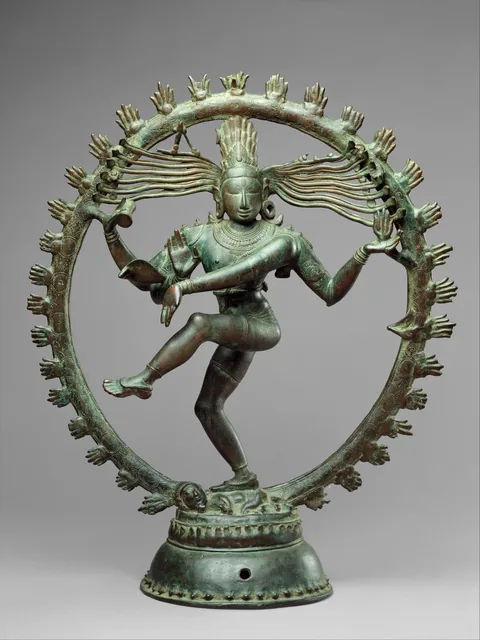
In the Chola Nataraja, a hand holds the drum and another carries fire. One hand reassures; another directs attention towards the raised foot. The planted foot subdues the figure associated with ignorance. Together the attributes offer a religious account of a universe that comes into being, changes and can be transcended. Read the relationships between the gestures, not simply a checklist of objects. The reassuring hand matters because the scene is also about refuge.
Sources: The Met: Shiva as Nataraja ↗
A bronze has a material history
The museum dates the illustrated bronze to approximately the late eleventh century in Tamil Nadu. Its workmanship is evidence of sophisticated metal casting and a flourishing sacred-art tradition. Historical study can ask how metal was obtained, how workshops transmitted skills and how worshippers encountered such images. Those are questions about people and objects. They sit alongside, rather than replace, a devotee’s understanding of Shiva’s sacred presence.
Sources: The Met: Shiva as Nataraja ↗
Stillness can support deliberate action
A short reflection inspired by Shiva may begin by noticing a restless reaction without immediately acting on it. Suppose a disagreement provokes an angry message. Pausing gives you space to identify the actual problem and choose words. This does not make anger unreal or require accepting injustice. It changes the relation between feeling and action. Meditation traditions are deeper than this small exercise, but a beginner can understand the distinction without attempting demanding breath control or austerities.
Appreciate an analogy without turning it into proof
The language of a cosmic dance can be a powerful way to think about change. A scientific theory, however, needs defined quantities, calculations and testable observations. A sculpture is not a particle-physics equation. Saying this does not diminish its religious or artistic significance. It lets us appreciate two kinds of achievement clearly: the image makes a spiritual vision visible, while an experiment tests a specified account of nature. Inspiration can travel between them without confusing their methods.
A respectful route into living worship
You may choose silent remembrance, a familiar prayer, reading about a Shaiva tradition or observing a temple’s worship. The Somnath Trust provides its own darshan page, a better starting point than an anonymous stream claiming to be official. A screen can introduce a place; it cannot convey every aspect of pilgrimage or communal worship. At home, a modest practice understood well can be more useful than copying a complex rite whose purpose and context are unfamiliar.
Sources: Shree Somnath Trust: live darshan ↗
PUT IT INTO PRACTICE
Work through an example
- Locate the drum, fire, reassuring hand and raised foot in the image.
- Write one sentence about what the sculpture shows and one about its meaning.
- Apply the pause-before-reaction example to a small disagreement.
Check your understanding
Why is “destroyer” incomplete?
Shiva is also approached through teaching, grace, protection and liberation.
What does the reassuring hand contribute?
It makes protection and refuge part of the image’s meaning.
Does a cosmic-dance analogy establish a physics result?
No. A scientific result requires its own mathematical and observational support.
Must a beginner undertake difficult austerities?
No. Reading, remembrance or an accessible reflection are possible beginnings.