
The core idea
Shakti means power or energy in Hindu religious thought; Devi is the Divine Mother approached through many forms. Durga’s victory over Mahisha presents protective strength. Navaratri and Durga Puja bring devotion, art, music and community together through regionally distinct practices.
Understand power as a religious concept
Shakti is not just physical force. In worship of Devi, the Divine is approached as active power and as Mother. The language includes nourishment and protection as well as the defeat of destructive forces. Calling Shakti “energy” does not automatically make it the measurable quantity called energy in physics. The words operate in different explanations. A religious concept can be meaningful without borrowing an experimental claim to make it respectable.
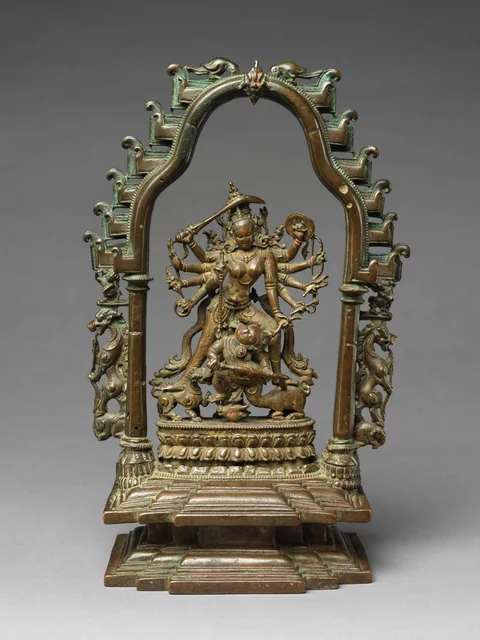
Sources: The Met: Durga slaying Mahisha ↗
Mahishasuramardini: read the action
Mahishasuramardini names Durga as the slayer of Mahisha. The pictured twelfth-century work from the Bengal region shows the many-armed goddess in conflict with the buffalo demon. Multiple arms make simultaneous divine power visible. They are an artistic and devotional language, not an anatomical lesson. Look for the relationship between the goddess, weapons and buffalo before interpreting the expression of the face. That order helps you recognise the scene rather than guess from one isolated feature.
Sources: The Met: Durga slaying Mahisha ↗
Navaratri and Durga Puja have regional forms
Navaratri refers to nine nights of devotion; Durga Puja gives particular prominence to worship of Durga. The Belur Math account explains its own sequence of awakening, worship, offerings and immersion. It is one named tradition, not a rulebook for every Hindu household. In another setting, the centre of participation may be music, dance, display, reading or temple worship. Ask what a practice means in that community before deciding that difference must be a mistake.
Sources: Belur Math: Durga Puja in the Ramakrishna tradition ↗
Strength can include making room for others
For a youth group, a useful reflection on protective strength is to examine who finds a celebration difficult to join. Can an older person sit down? Is there a quiet way to participate? Can a volunteer say they are tired without being shamed? These are our practical questions, not claims that a scripture specifies the layout of a modern event. They connect a celebration’s intention with how people experience it. A grand display and attentive care need not be the same achievement.
Participate without pressure
You may choose reading, singing, visiting a pandal, a simple offering or helping with a community meal. Fasting is part of some observances, but this guide does not prescribe it or treat it as a measure of devotion. Health needs, age, work and family circumstances matter. Where lamps or incense are used, a stable supervised place and clear walking routes make participation easier. A visitor can respectfully observe without claiming to know a community’s entire ritual sequence.
A festival date and an office holiday answer different questions
A festival calendar tells you about an observance. A government notification tells you which specified offices close. Even the date of a closely related celebration can vary by region: our calendar preserves IMD’s separately named regional entries rather than merging them. Before arranging a visit, use the organiser’s current programme. Before planning time off work, use your employer’s holiday list. This keeps the meaning of the celebration visible without turning a religious date into a universal closure claim.
Sources: IMD: Rashtriya Panchang 2026–27 ↗
PUT IT INTO PRACTICE
Work through an example
- Identify the goddess, buffalo and weapons in the image.
- Choose one form of participation that fits your circumstances.
- Plan one change that helps another person participate with dignity.
Check your understanding
Is Shakti identical to a quantity measured in joules?
No. Here it is a religious concept; the physics term has a different defined use.
What does Mahishasuramardini mean?
Durga as the slayer of Mahisha.
Must every community use the Belur Math sequence?
No. It documents a particular living tradition.
Does a festival listing guarantee an office holiday?
No. Office closure depends on the applicable notification or employer.