
The core idea
Sukhakarta Dukhaharta is a Marathi devotional aarti addressed to Ganesha. Its movement is from praise and a description of the adorned form towards a personal request for help and protection. Understanding this movement makes participation more attentive than merely memorising the sound.
Start with a named text
The Siddhivinayak Devasthan at Anjur publishes an aarti collection used in its own worship. Page 3 contains this Ganapati aarti. It gives us a concrete text to read rather than a recollection pieced together from social-media captions. The work is traditionally associated with Samarth Ramdas; the closing stanza uses the signature “servant of Rama”. A text and its living singing tradition are related, but pace, repetition and pronunciation can vary across households.
Sources: Siddhivinayak Devasthan, Anjur: aarti collection, page 3 ↗
Happiness, suffering and obstacles
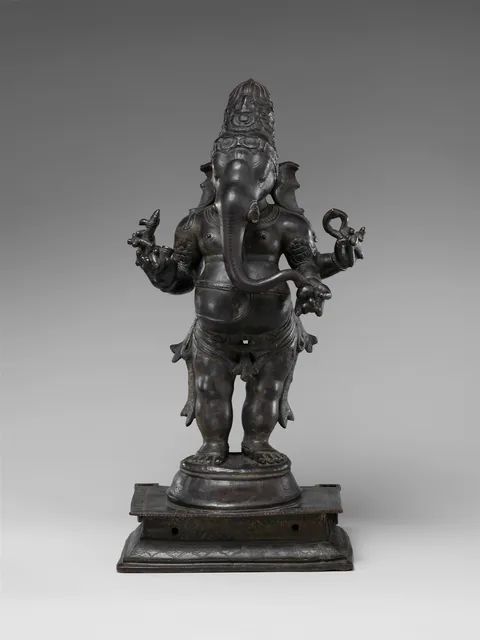
The opening addresses Ganesha as giver of happiness and remover of sorrow. It then turns to grace and to the adorned form: vermilion covering the body and a necklace of pearls. This is a devotional address, not a contractual statement that singing guarantees a particular material result. In reading it, identify who is speaking and to whom. The worshipper’s praise creates a relationship of trust and dependence; the descriptive details help focus the attention on the form before them.
Sources: Siddhivinayak Devasthan, Anjur: aarti collection, page 3 ↗
Why a refrain helps a community sing
The repeated “Jai deva” refrain praises the auspicious form and speaks of fulfilment through darshan. Darshan involves seeing and being in the presence of the revered form. Repetition gives newcomers a way to join before learning all the stanzas. It also brings attention back after each description. A beginner may first read the refrain, listen to a trusted rendition and then join gently. Loudness or speed is not a reliable measure of understanding.
Sources: Siddhivinayak Devasthan, Anjur: aarti collection, page 3 ↗
Read the ornamentation as praise
Later lines describe Gauri’s son with sandalwood, saffron, a jewelled crown and sounding anklets. Such details make the beloved form vivid. They do not function as a shopping instruction for the listener. The final movement becomes more personal: the speaker waits and asks for support in difficulty and protection. When a poem changes from description to address, notice the change in relationship. You can learn this reading skill in devotional poetry and carry it into other literature.
Sources: Siddhivinayak Devasthan, Anjur: aarti collection, page 3 ↗
Worked reading: three columns
Draw three columns headed “image”, “feeling” and “response”. For the pearl necklace, write a visible adornment, admiration and attentive looking. For the request for protection, write no visible object, vulnerability and asking for help. This prevents the reading from becoming only a list of ornaments. It also helps you distinguish literal description from the emotional work a line is doing. Your response is an interpretation; compare it with the words rather than replacing them.
A possible way to learn the aarti
Read one stanza and the plain-language explanation, then listen to the same stanza. If you want to sing, keep the printed text visible and leave room to learn words gradually. Our reader provides the traditional text and a transliteration; browser speech is for hearing the explanation, not a substitute for a musical rendition or a pronunciation teacher. You may also simply listen respectfully. Learning with attention does not require claiming expertise in Marathi after a single reading.
PUT IT INTO PRACTICE
Work through an example
- Read the first stanza and identify two visual details.
- Explain the difference between an ornament in a poem and a required purchase.
- Complete the three-column exercise for the final request for protection.
Check your understanding
Which language is this aarti in?
Marathi.
What is the role of the refrain?
It returns attention to praise and helps a group participate.
Are the jewels a compulsory materials list?
No. They form the poem’s devotional description.
Can someone participate by listening?
Yes. Singing is an option, not a requirement imposed by this guide.